CO2 in time and space

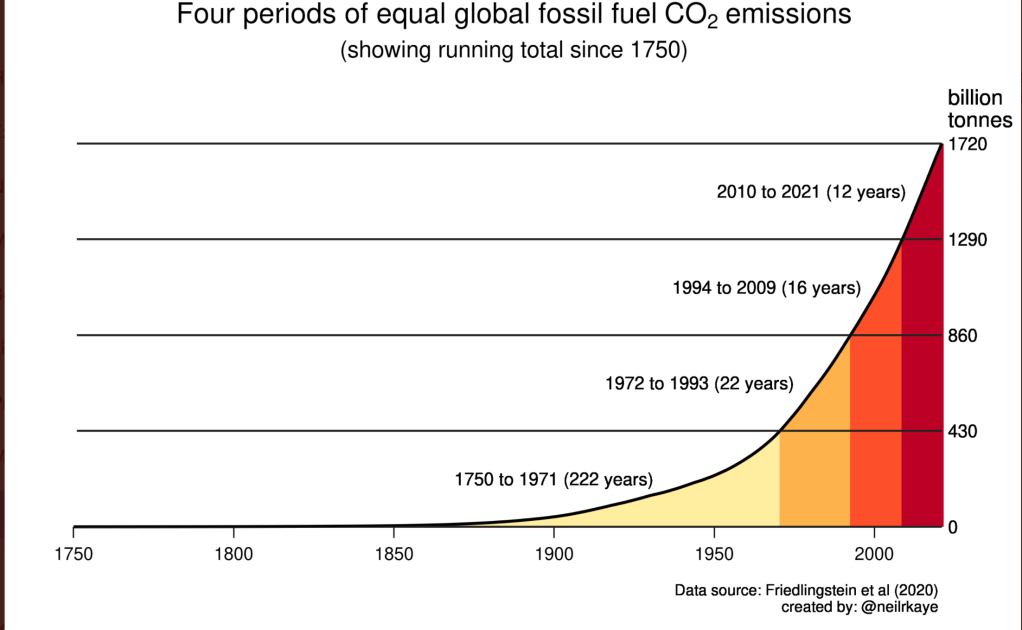
Half of emissions took place after Kyoto, a quarter in the past 10 years

This chart show emission intensity and szie per country, look how small Africa, and the width of Africa will double during this century

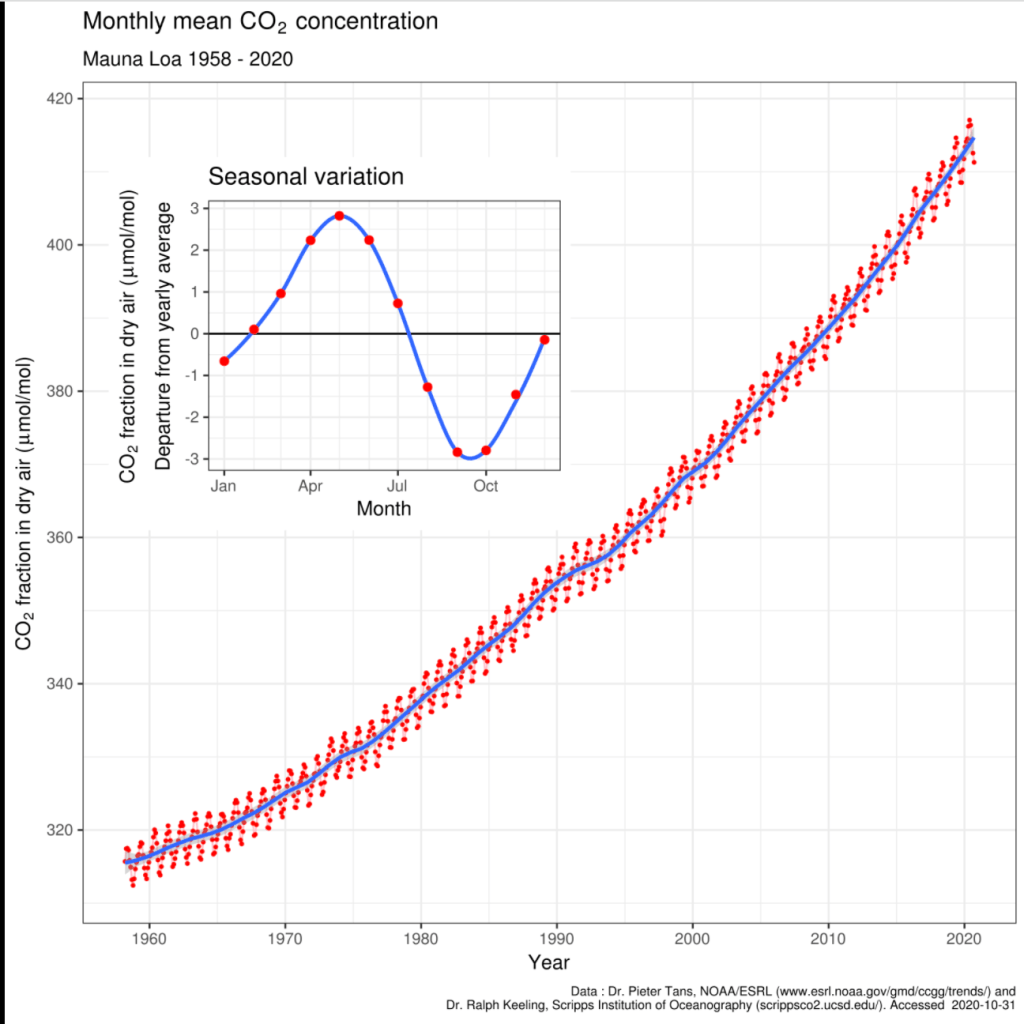
emissions are exponential, CO2 concentration in the atmosphere, exemplified by the famous Keeling curve measured at Mauna Loa, it seems linear, but really a polynomial fit wors better https://plotnick.medium.com/goodbye-400-ppm-the-statistics-of-the-keeling-curve-5a79586d1b2e

I am wondering, emissions are exponential, co2 concentration is nearly linear, how does global warming behave ? LEt’s go and look for a radiative forcing curve. Found on wikipedia, seems linear

and so is temperature grwoth vs 19th century baseline, we are at 1,07 degrees now. Which seems linear since we have been measuring co2 concentration in the atmosphere

and then we have climate, which is a complex system which might have feedbacks and tipping points.

reading oct 14th

today IEA Global Energy Outlook 2021 I only read te executive summary and they are bullish green electrification and worried low investements, growth CO2 emissions, scenarios for 2.1 and 2.6 degrees warming in 2100

bullis, they got the accelerating adoption of EV cars and renewable propelled by low costs. New paradigm building? How far we are in Carlota Perez tech revolutions framework ?

Strateachery reads Carlota Perez https://stratechery.com/2021/the-death-and-birth-of-technological-revolutions/

New York State, EVs, renewables and the grid, ain’t smart won’t be enough https://www.washingtonpost.com/s/business/2021/10/13/electric-vehicles-grid-upgrade/?pwapi_token=eyJ0eXAiOiJKV1QiLCJhbGciOiJIUzI1NiJ9.eyJzdWJpZCI6IjM5MjQ4OTAyIiwicmVhc29uIjoiZ2lmdCIsIm5iZiI6MTYzNDE0NjQ2MiwiaXNzIjoic3Vic2NyaXB0aW9ucyIsImV4cCI6MTYzNTM1NjA2MiwiaWF0IjoxNjM0MTQ2NDYyLCJqdGkiOiI4NWEyY2VmYS00MjI4LTRkNTItOWFiYy02ZTI0MGI1YmMxMmMiLCJ1cmwiOiJodHRwczovL3d3dy53YXNoaW5ndG9ucG9zdC5jb20vYnVzaW5lc3MvMjAyMS8xMC8xMy9lbGVjdHJpYy12ZWhpY2xlcy1ncmlkLXVwZ3JhZGUvIn0.KpuLcTRIjF1ry7Rn8Vlc_0Y6hyezg9k1tHRBZzItp8Q&utm_medium=email&utm_source=nextdraft&fbclid=IwAR04zPt5ZvWep9HkeMaS5fPmgXjxM617KlSuQaXEO92UjYSTJCu3CNCbWnA

reading oct 13th 2021

paleogenetics: in 2000 the story as, there’s a long line of devlopement, Neanderthal lost, we are at the top. Today with paleogenetics, 100k years all sorts of different human species, a bottleneck 60k years ago https://razib.substack.com/p/here-be-humans

Uno studente di Graeber racconta la persona e le sue idee. Titoli che non ha usato “come fossimo già liberi” e “We ve neve been stupid” meglio di “The Dawn of Everything” https://gliasinirivista.org/david-non-ci-vorrebbe-graeberiani/

found again an old Franzen on climate hange, now that I am reading Crossroads “Call me a pessimist or call me a humanist, but I don’t see human nature fundamentally changing anytime soon. I can run ten thousand scenarios through my model, and in not one of them do I see the two-degree target being met.”https://www.newyorker.com/culture/cultural-comment/what-if-we-stopped-pretending

Graeber & Wengrow on Rousseau’s question

https://www.eurozine.com/change-course-human-history/

Rousseau wisdom “‘All ran headlong for their chains in the belief that they were securing their liberty; for although they had enough reason to see the advantages of political institutions, they did not have enough experience to foresee the dangers’”

on revolutions, forget the story how it was told to us far “It’s probably no coincidence that today, the most vital and creative revolutionary movements at the dawn of this new millennium – the Zapatistas of Chiapas, and Kurds of Rojava being only the most obvious examples – are those that simultaneously root themselves in a deep traditional past. Instead of imagining some primordial utopia, they can draw on a more mixed and complicated narrative. Indeed, there seems to be a growing recognition, in revolutionary circles, that freedom, tradition, and the imagination have always, and will always be entangled, in ways we do not completely understand. It’s about time the rest of us catch up, and start to consider what a non-Biblical version of human history might be like.”

“A hundred years ago, most anthropologists understood that those who live mainly from wild resources were not, normally, restricted to tiny ‘bands.’ That idea is really a product of the 1960s, when Kalahari Bushmen and Mbuti Pygmies became the preferred image of primordial humanity for TV audiences and researchers alike”

“40,000 years is a very, very long period of time. It seems inherently likely, and the evidence confirms, that those same pioneering humans who colonised much of the planet also experimented with an enormous variety of social arrangements. As Claude Lévi-Strauss often pointed out, early Homo sapiens were not just physically the same as modern humans, they were our intellectual peers as well. In fact, most were probably more conscious of society’s potential than people generally are today, switching back and forth between different forms of organization every year”
Bundles and profits

sometimes you have to bundle different modules in order to deliver a good-enough product, it depends on technology and context, but those can change, the prodcut can be commoditised and a competitors can unbundle the product and compete on single modules. Where do the profits of integration go? Are they lost? Christensen states the law of conservation of attractive profits, under the new technology and market arrangements, opporutinity to re-intergate in contiguous modules of the value chain emerges and the profits will go to the new intergated product

So it is a cycle of bundling and unbundling with profits jumping from the bundled up to the unbundled and the the bundler again

There’s a business saying “In business, there are two ways to make money. You can bundle, or you can unbundle.”
– Jim Barksdale

“When attractive profits disappear at one stage in the value chain because a product becomes modular and commoditized, the opportunity to earn attractive profits with proprietary products will usually emerge at an adjacent stage. That is, the location in the value chain where attractive profits can be earned shifts in a predictable way over time.”

-Clayton Christensen

Jim Barksdale was Netscape CEO to the end, then secretly built the optic fiber cable linking Chicago to New York, shaving 3 millisecond in the transmission time, such a tiny speedup that only algorithimic traders could appreciate it. The way of market arbitrage are infinite, infinitely small

Mutual Aid

Kropotkin was no crakcpot this was biologist Stephen Jay Gould in 1988, mostly on the basis that K. built on the work of Russian biologists in the arctic and the taiga where you don’t get much competitive darwinism on which anglosaxon scholars have been fixated, with conseguent social darwinism ideas being derived

I found it on Graeber’s intro to a new edition of Kropotkin’s Mutual Aid

There I discovered Murray Bookchin, or maybe rediscovered? I had Post-scarcity Anarchism on some reading list, SF related, Bank’s Culture books I guess. What I did not know it is that he inspired the Rojava confedralism during the Syrian war.

From Gould: ” I like to apply a somewhat cynical rule of thumb in judging arguments about nature that also have overt social implications (..) I see no evidence for Teilhard’s noosphere, for Capra’s California style of holism, for Sheldrake’s morphic resonance. Gaia strikes me as a metaphor, not a mechanism. (Metaphors can be liberating and enlightening, but new scientific theories must supply new statements about causality. Gaia, to me, only seems to reformulate, in different terms, the basic conclusions long achieved by classically reductionist arguments of biogeochemical cycling theory.)

TMFTF

things that work in TMFTF:

aerosol in the atmosphere to increase albedo, maybe

ecoterrorism, defintely so

slowing glaciers by pumping out water at the bottom, keeping oil riggers happy

organic agriculture, overcoming modernism in agriculture. It also sequesters carbon in the fertile level of the ground

CQE Climate Quantitative Easing, creating a crypto and allocating it to carbon sequestration

wildlife corridors averywhere

upgraded management of water resources, generally caring for things rather than not

easier said than done, but moving away from capitalism will help

nations states will stay, central banks will take leadership in financing postcapitalismm with cretive money.

China will rush ahead of US

and yeah ! Diirigibles and blimps everywhere, hypertech sailboats with 7 masts, that’s the way to go

ITW with the author https://jacobinmag.com/2020/10/kim-stanley-robinson-ministry-future-science-fiction

crooked timber run a series of posts on the book, Robinson replied, start from his reply and you will find the 8 articles https://crookedtimber.org/2021/05/14/response-7/

There be (sumerian) dragons

Tricia verver, archeoplogist, tells the story of the Hazaras, Shia Muslims who have myths about dragons (and a very peculiar lake in their valley) Precarious Life: the fate of the Hazara people in Afghanistan.

A couple of weeks ago much riting on Afghanistan, a few explainer of the ethnic composition. In one I found this

some Pashtun Afghans officers who told me a story of a militant fighter they had captured right after the 2001 invasion who came from an isolated valley along the Pak-Afghan border.  This man, along with his tribe, believed the sun is a jewel vomited by a dragon each morning and then swallowed by that same dragon again on the other side of the world each night after the dragon has rushed under the (presumably flat) earth all day to catch it

Among Afghans: jewel of the dragon by Razib Kahn, reccomended

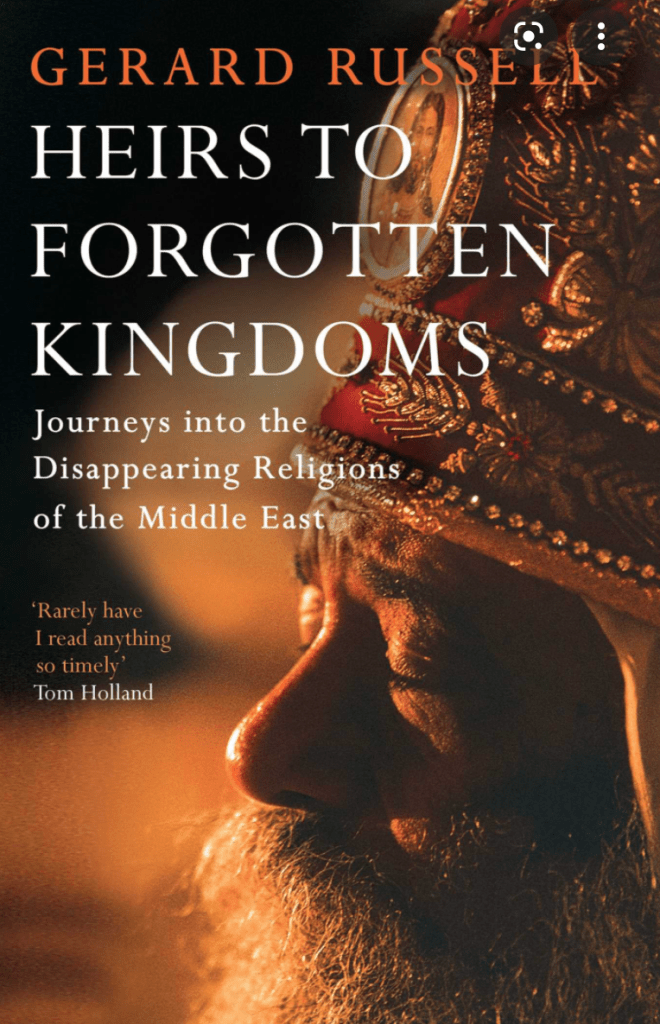
Dragons are sumerian, I understand. religions with pre-Islam myths still survive in the middle east, Dragons be one of those myths. You know the Mando and Mandalorians? Be aware that in the delta of the tigri and euphrtae there is a people called Mandeans with a peculiar iniziatic religion. There’s a book to tell their story, plus some other surviving Babilonian religions in the area.

A book: Heirs to the Forgotten Kingdoms by Gerard Russel – Goodreads

Another book, this time on Dragons and generally the depiction of monstrous creatures in history, or better, The fortune of dragons from the bronze age on 🙂

The Origins of Monsters: Image and Cognition in the First Age of Mechanical Reproduction by David Wengrow

from the bottom, one can still make the difference

forget rousseau democracy and the centralized, fake-modernist, ultimately a scam of the rousseau platform

a bit of direct digital government can be seen in action now on euthanasia and cannabis referendum, which can be signed digitally with Spid

Stefano Quintarelli got Spid approved in Parliament working on it over 3 years and 3 governments https://www.repubblica.it/tecnologia/2016/03/08/news/genesi_spid-135026906/

The Radicali, Associazione Luca Coscioni, Magi and Cappato got the parliament to approve the use of Spid for collocting signatures toward a new referendum https://www.repubblica.it/politica/2021/08/12/news/via_alla_firma_digitale_per_i_referendum_in_tre_ore_18_mila_adesioni_al_quesito_sull_eutanasia_transizione_digitale-313814641/

Spid is a public platform of digital identity https://it.wikipedia.org/wiki/SPID