real slim shady

the real slim shady please stand up 1; Amazon, a guy develops a tripod business worth 3,5 mio usd on amazon, amazon clones it with essential. Bad amazon, but it delivers 30% discount to consumers. The guy just designed and produced in china, no moat. Amazon replicates a good design and prodiuces in the same chinese plant, cheaper because of size. In the end that is the beauty of internet and globalization but an old ordoliberist like ne says “chinese wall” because it is the ugly of a company setting up a trap for you producer.

the real slim shady please stand up 2: Stihl does not advertise on facebook but chinese knockoffs do: Stihl complains but Facebook does nothing. Who are you kidding FB? Your admin panel can search Stihl keywords in no time and block the Chinese knockoffs. Likewise, if you had cared for your users instead just money, you could have searched and discovered the messages organizing the killings in Myanmar, just if wished it. So anyone out there, bring your justifications for saying Zuck is in the right, like free economy, profit is legal bruahahaha, I will look for any proof he is in the wrong because he is, customers come first and Facebook first customers are users and they come first of the first, call it stakeholder instead of shareholder value, Facebook could have built itself to stop genocides while it did not, facebook is in this respect criminal in his exploitation of users and must be stopped

Are billionaires evil?

Paul Graham, who says his job is making billionaires, can say that billionaires are not bad people and goes on explaining why: http://paulgraham.com/ace.html

Why did he fgeel compelled to say that? It must ll the breakup Facebook bruahahaha that is digging dirt from the social network which seems having been 100% profit making so something bad might have happened. You might be disgruntled as a user when you see your friends ganging up on some screwerd up cause, but if you are minority in a country and the cause is killing you you might hold more of a grudge against Zuck, if you manage to survive, that is.

Anyway, are you a communist that denies the right of entrepreneurs to make profit? Not so easy

But the post need not be on Facebook, I wanted to pin something on why orgnizations like companies screwup.

The Gervais Principle or the office according to The Office

more to come

Facebook, antitrust, Reagan, Bork

better understand Facebook antitrust case by looking back at Reagan times when the antitrust law was reinterpreted to restrici it to “consumer harm”

the whole sotry is told by Doctorow https://pluralistic.net/2020/12/10/borked/#zucked

“For instance, in a 1979 decision, the Supreme Court, quoting Bork’s Antitrust Paradox and relying on his fabricated account of congressional intent, stated “Congress designed the Sherman Act as a ‘consumer welfare prescription.’”” https://promarket.org/2019/09/05/how-robert-bork-fathered-the-new-gilded-age/ Bork re-interpretation steered antitrust law toward ant-collusion and makes possibile to use it against workers “colluding” to protect themselves

the key to facebook case is demonstrating that democratic harm is indeed consumer harm

“In 2019, Dina Srinivasan published a landmark paper: “The Antitrust Case Against Facebook,” which made incredibly clever arguments showing that FB’s democratic harms were also consumer harms, meaning FB could be sued without first undoing Borkism.

https://papers.ssrn.com/sol3/papers.cfm?abstract_id=3247362

UPDATE 30 june 2021 2 weeks ago Lisa Khan, antitrust scholar was sworn in as president of the Federal Trade Commission https://en.wikipedia.org/wiki/Lina_Khan

while yesterday we saw Borkism in action when the judge  dismissed two antitrust lawsuits against Facebook Inc., brought by the U.S. Federal Trade Commission and a group of state attorneys general

Clearly, consumer welfare isn’t at risk with free service, no price hike even if facebook dominant position in social networking was demonstrted, so FB isn’t a mkonopoly, now thye batlle will be to promote a different interpretation of antitrust law, away from borkism, Matt Levine call it “hipster antitrust” really ? I like it. “Facebook Is Big But Maybe Not a Monopoly” https://www.bloomberg.com/opinion/articles/2021-06-29/facebook-victory-against-the-ftc-is-an-antitrust-lesson-in-monopoly-power-kqi8jeku

2 letture per il giorno di festa, distopia e golpe

Noah Smith propone una distopia, plausibile ma secondo lui non la più probabile. Al centro sempre la Cina con il mix di autoritarianismo e tecnologia, il partito che si arma di intelligenza artificiale per controllare ogni piccolo evento della vita dei cinesi, allenando tutto sulla oppressione degli Uiguri https://noahpinion.substack.com/p/the-super-scary-theory-of-the-21st

Zeynep Tufekci sociologa USA di origine turca, lamenta che laddove in Turchia ci sono diversi termini per descrivere ogni tipo di golpe, in USA ne hanno uno solo e non riescono a cogliere in pieno il rischio del ridicolo comportamento di Trump dopo le elezioni, che giunge dopo anni di occupazione e imbastardimento della politica americana, gerrymandering etc.

Anche Napoleone III era un pagliaccio che fu portato al potere proprio per essere una macchietta, salvo poi prenderselo e farsi imperatore , per lui Marx disse “Hegel says somewhere that that great historic facts and personages recur twice. He forgot to add: “Once as tragedy, and again as farce.” https://www.theatlantic.com/ideas/archive/2020/12/trumps-farcical-inept-and-deadly-serious-coup-attempt/617309/

Quantum supremacy take 2 (and house warming)

a new demonstration of #quantumsupremacy via #bosonSampling, i.e. solving a calculation problem made with a quantum computer in a time impossible for a traditional computer

It is not therefore a question of having demonstrated a universal, foolproof, scalable or simply useful computer. But the Boson Sampling approach could be useful to go in that direction

The demonstration was made in China, for all the answers, for what we can understand, I refer you to Scott Aaronson who is the referee of the report.

Funny Story as told by Scott:

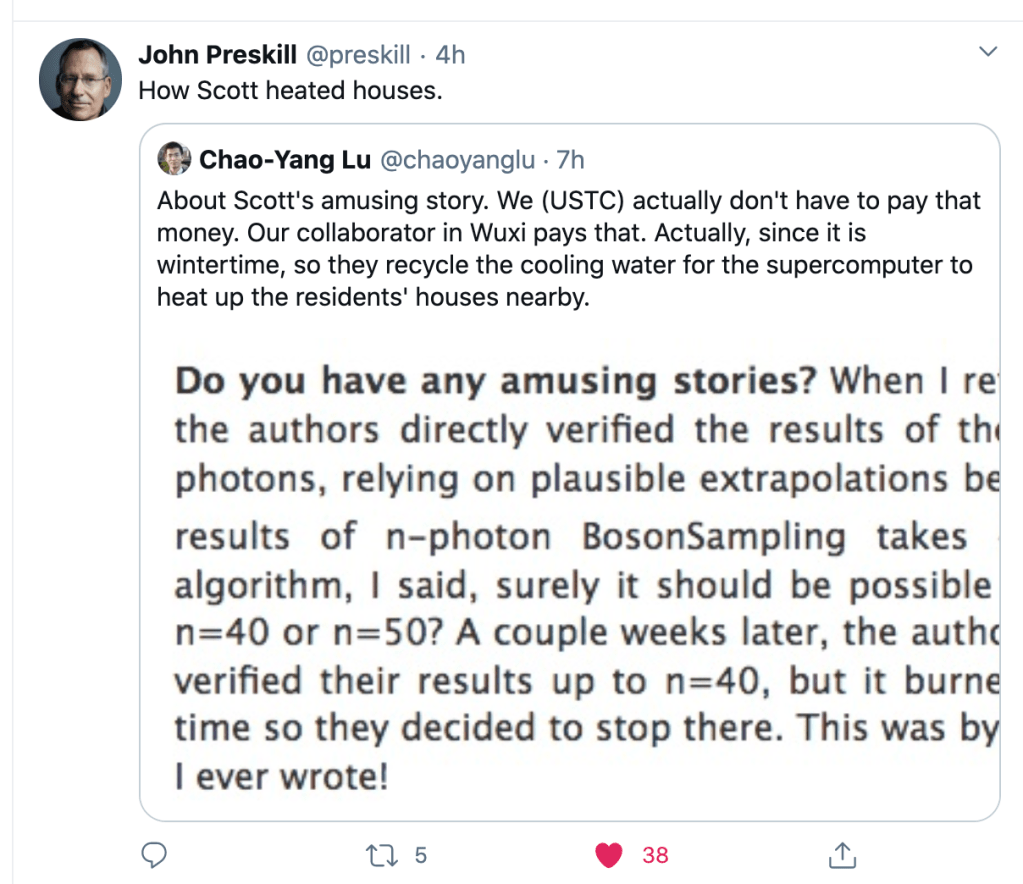
When I refereed the Science paper, I asked why the authors directly verified the results of their experiment only for up to 26-30 photons, relying on plausible extrapolations beyond that. While directly verifying the results of n-photon BosonSampling takes ~2n time for any known classical algorithm, I said, surely it should be possible with existing computers to go up to n=40 or n=50? A couple weeks later, the authors responded, saying that they’d now verified their results up to n=40, but it burned $400,000 worth of supercomputer time so they decided to stop there”

the conversation on Twitter, tha authors did not get properly billed, their sponsor footed the bill, also becasu all went into residentail heating of the nearby houses https://twitter.com/preskill/status/1334900457894891520

Chips and disruption

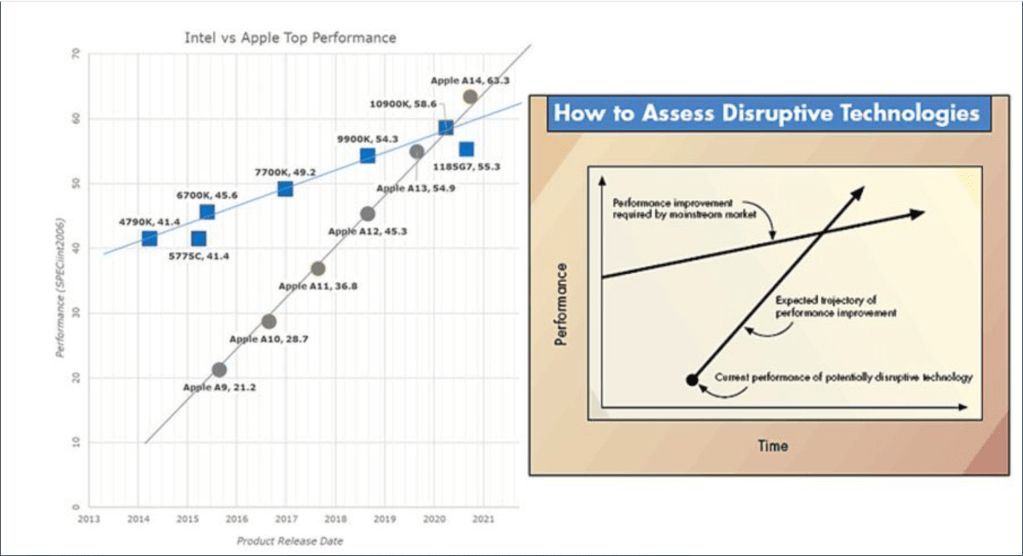
Forget those abuser startupper who banter of disruption every 3 words. We just had the most classical, Christensen-approved, disruption and involved Apple and Intel, not pizza&figs

Apple ARM chip just got more powerful than Intel’s x86 and will zoonotically colonize the Mac Power Book. Chart from this intereseting medium on Intel and disruption https://jamesallworth.medium.com/intels-disruption-is-now-complete-d4fa771f0f2c

that could be read in the tea leaves, no, in the tech trajectories already long time ago, Daring Fireball did it in 2015 https://daringfireball.net/2015/11/the_ipad_pro

Truth be told, Christensen did (not) explain that to Grove in the late 90’s and Intel could pull the Celeron out of the magic cap and so avoid disruption then, Plan Maestro had the story in 2016 https://twitter.com/PlanMaestro/status/712103828426870784

Greek (myths and) technology

greek myths speak of robot, prostetic, drugs and body augmenting technologies https://www.noemamag.com/gods-and-robots/

she is the author of the book https://www.goodreads.com/book/show/40740411-gods-and-robots?ac=1&from_search=true&qid=3jje3xQUa2&rank=1

La rivoluzione dimenticata di Lucio Russo https://www.goodreads.com/book/show/4146890-la-rivoluzione-dimenticata?from_search=true&from_srp=true&qid=6KCdkBtzuY&rank=1

Facebook break-up would be hard? Think again

Facebook break-up would be hard

but really it would be soft, a software problem and in the world of clouds and API’s what can’t be done with software ?

Pun intended, Facebook breakup isn’t hard, it is soft, it’s a matter of designing it and can be done. This is Dave Winer proposal, perfectly doable and sensitive. http://scripting.com/2020/10/07/001200.html?title=breakingUpTechCompanies

I quote in full:

“Find the component of the company that really is open tech. Something that was open before they came along, that they foreclosed on, and used their monopoly to put everyone else out of business.#That’s where you draw the line of separation. The core should be spun off into a new company that’s well funded, with a charter to commercialize the tech while maintaining zero lock-in. Totally replaceable. Defined APIs that don’t break.#If the company is viable with these constraints, great. If not, they have enough money to plan their own demise. The key thing is they cannot use their dominance to launch new products. Just the open tech.#You would find people willing to staff such a company, there are lots of idealistic developers, still, who believe in the open internet.#In Microsoft’s case, in the 90s this would have meant spinning out the browser. #Today with Facebook it would mean spinning out the open graph.#With Google, it would have to be at least the core search engine. If Alphabet wanted to run ads on search, they’d have to get in line and compete with others who did. This is the price they pay for trying to use their dominance in search to control everything.#Google would also have to spin out Chrome, same way Microsoft would have spun out MSIE in the 90s.#That’s the basic idea. Look for the old open tech buried in the company, that is the source of their monopolistic control, and extract it. Hopefully it’s very painful, to keep successors from tying to do it in the future.#

other ideas: by law hardware and software in different hands, cloud companies that host service companies. Google and Facebook give up datacenter and related competencies. They only own whatever service they can build on software, government can ask to recombine

Ben Evans https://www.ben-evans.com/benedictevans/2020/8/10/would-breaking-up-big-tech-work

(he plays down the effect of Standard Oil and At&T sorto I am smarter you do magical thinking, but comes out at times justificationist and argue with things: since copper network don t get replicated, what let you think that splitting MS will have more OS created, physical natural monopoly mixed up with digital network effect. In the end lots of cues, he says don’t break up, unbundle services like for example Telecom DSL at the local loop. He’s on poimnt showing we will be dealing with local regulations on global networks)

Stratechery here https://stratechery.com/2020/anti-monopoly-vs-antitrust/ and here https://stratechery.com/2019/tech-and-antitrust/

Recombine services why: deliver more values to the customer (free me from crappy Linkedin algo for example)

but also delivering more innovation in tech and services, a Facebook not just obsessedn with spamming advertising with 90% gross revenue, what could do of new and wonderful with the 90% cumulated in their coffers once it is told to unbundle and become more companies

the strange feeling of these days: everybody talking about the new wave of bundling and unbundling on the web, and in absence on any hard science explaining the come and go of the bundle fashion, we are left to quote somebody saying “companies bundle, and then unbundle”. Management science explained.

What if we frame the break-up issue as unbundling, give it the same timeframe companies usually takes to do it, of course we have to come up with a design for the facebook group of companies. How many things are bundled there together?

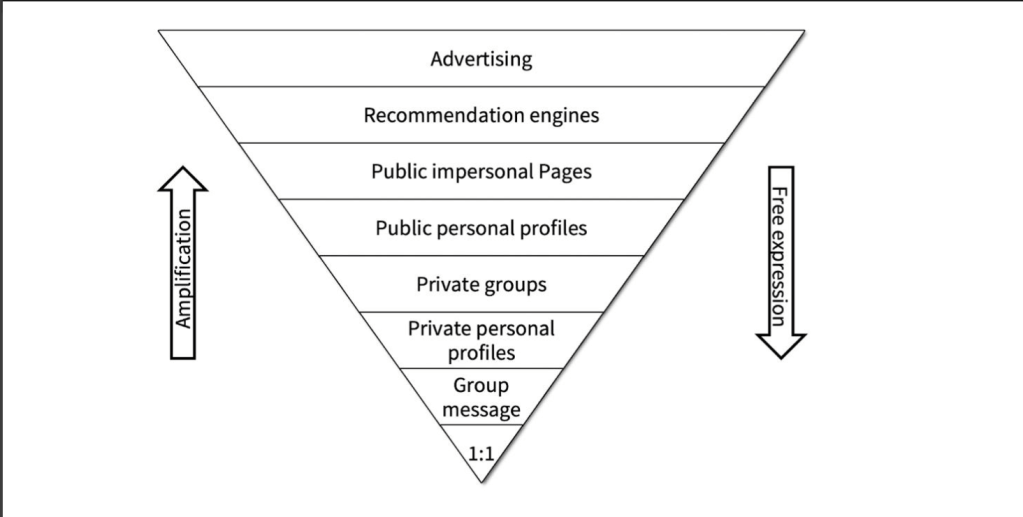
Start from the privacy stratigraphy offered by Alex Stamos https://galley.cjr.org/public/conversations/-LsHiyaqX4DpgKDqf9Mj

Another issue, too big to break-up, stock market will suffer, wealth will be destroyed, poor microsoft missed things during it antitrust trial

Surely this argument will be used, so it is necessary to develop and prove a counterargument showing that innovation will deliver more benefits in the longer run. Antitrust will have to deal with innovation not just the customer

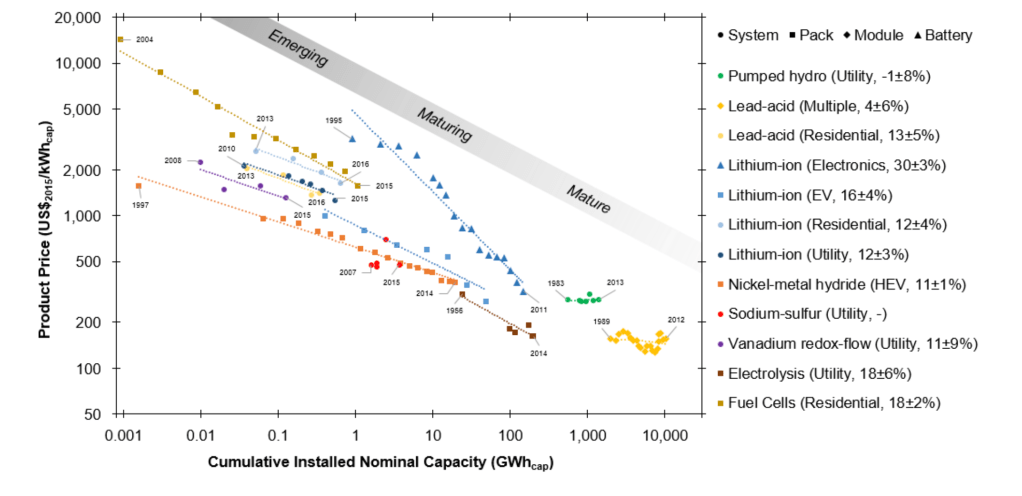
Learning and experience curves

“The difference between learning curves and experience curves is that learning curves only consider time of production (only in terms of labour costs), while experience curve is a broader phenomenon related to the total output of any function such as manufacturing, marketing, or distribution”

looking for data of experience curves on Electrolysis I found this

on this paper on cost trajectories of main electricity storage technologies

this article states 20% learning rate per doubling of production, similar to wind https://about.bnef.com/blog/liebreich-separating-hype-from-hydrogen-part-one-the-supply-side/

a paper on learning in electrolysis for green hydrogen https://onlinelibrary.wiley.com/doi/10.1002/solr.202100487

internet e regolamentazione

questo è il mio amico chris che chede un intervento pubblico sui social network https://www.linkedin.com/posts/christianvollmann_thesocialdilemma-activity-6715723568925155328-GzL3

la cosa curiosa è che Chris è il founder di un social network, lui stesso
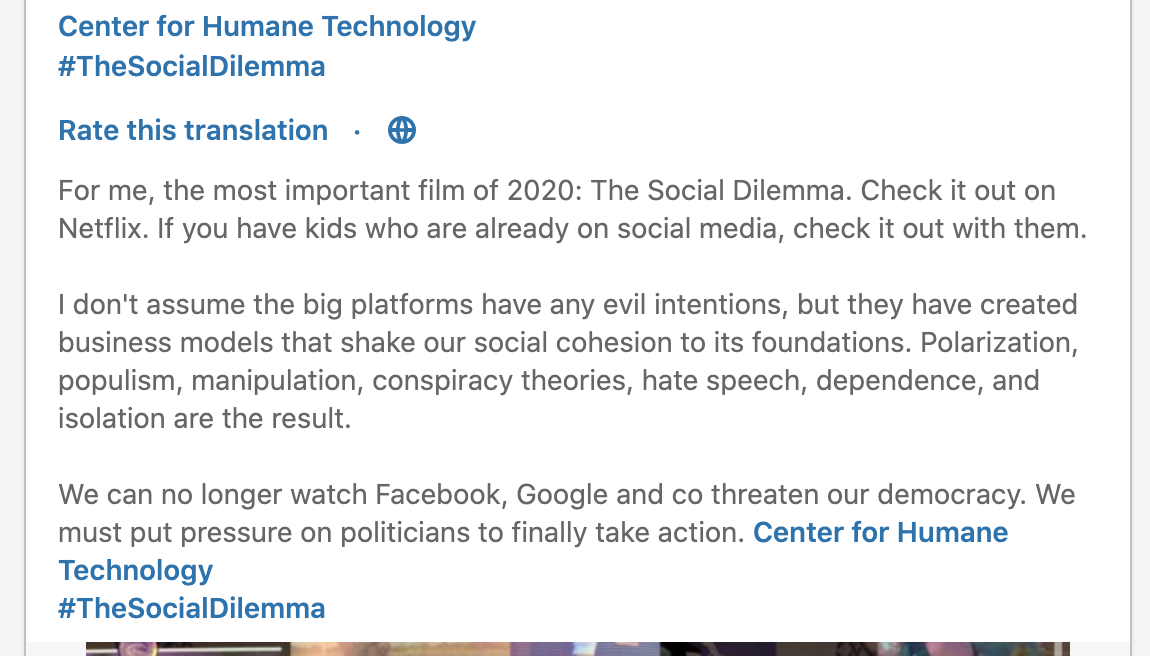
Leggendo nei commenti al post Linkedin, il suo orgoglio è avere l’unico social network con un feed cronologico, non algoritmico; ma questa non è proprio la soluzione, non centra l’obiettivo

Ben Evan che leggo e seguo con piacere, persona in gamba con una vista acutissima, dice che l’algoritmo è un must, i feed non possono scalare oltere un n di relazioni su feed cronologici, numero di Dunbar, ci deve essere una regola dinamica che decide cosa mostrare e cosa no https://www.ben-evans.com/benedictevans/2018/4/2/the-death-of-the-newsfeed

e questo, detto in difesa di Facebook contro controlli politici o breakup, mi colpisce ad un tempo come vero e come detto con miopia

E’ abbastanza chiaro che gli algoritmi siano sviluppati per gli ads e la monetizzazione; se fossero sviluppati in prima istanza per lo user sarebbero diversi, più efficaci e rilevanti, forse meno manipolabili

La mia epifania è stata sul beta dell’assistente google su Android, Google Now credo si chiami o si chiamasse. Forse anno 2013 o 2014, scopro casualmente che ogni giorno mi suggerisce due articoli in 2 tematiche (non specificate da me) che erano davvero in quel momento il pivot del mio interesse, anche inespresso anche perchè forse non erano il bulk della mia attività. Il senso di rilevanza di quei suggerimenti, l’utilità di quei link, ho subito amato google now, una vera epifania.

poi google now esce di beta, quel giorno invece di quei due solitari ma graditissimi suggerimenti, mi trovo una pagina di risultati di calcio di serie A (non seguo il calcio) e l’invito a personalizzare il feed, che anche con ripetuti tentativi è rimasto stupido e stupidamente vago. Il modello era cambiato: se vuoi max gli adv revenue meglio che fai conto sulla folla dei football fans, non sui miei specificissimi pivot. Non lo uso più e con buona pace, ogni volta che lo apro per sbaglio le notizie al top sono siti populisit/sovranisti con titoli clikcbait e temi confinanti al fake; capisco la “gravità” del feed algoritmico, se affinato sulla massimizzazione di click e adv$ si finisce a fondo verso la parte più becera e ossessiva del pubblico.

Il problema per me è chiaro e risolvibile, nel mio caso io non sono contro ad essere profliato per se, io sono l’essere profilato al solo beneficio degli inserzionisti. Impegnati a farla funzionare solo per i propri clienti, FB e google sono patentemente incapaci di capire il valore che la mia profilazione ha per me stesso.

la soluzione sarebbe in nuove piattaforme e tecnologie che rendo la mia profilazione sinergica alla crescita del mio profilo online, ad esempio google attraverso chrome sa tutto quello che ho visitato negli ultimi 10 anni e potrebbe tranquillamente offrirmi una search semantica per aiutarmi a ricordare e ritrovare, ma che incentivo ha google a farlo e chi altri potrebbe farlo ?

“”””e tornado al pessimismo di Ben Evans, io credo che le stesse tecnologie di oggi potrebbero rendere il mio feed algoritmico una esperienza molto più dinamica, interattiva, libera dalla schiavitù del “tutti i tuoi amici hanno visto questo, vedilo anche tu”. Internet non è la televisione””””

il problema non risolvibile è che, in un mondo di economie di rete infinite e di monopoli naturali si riducono le possibilità che nuove proposte ad un problema non chiaramente riconosciuto riescano a bucare i muri dell’attenzione, e nel caso riuscissero a farlo rimanere indipendenti e non essere fagocitati dai vari big (though in internet i settori per l’analisi del monopolio possiamo poi parcellizzarli molto di più che ad esempio nel settore dell’acciaio)

in concreto, c’è tanto cognitivismo al lavoro nel forzare il click compulsivo, poco dello sforzo che si possa fare per ridare il controllo all’utente riuscirebbe ad emergere. Il click compulsivo arriva per primo ai miliardi. TikTok adesso vince perchè ha costruito la piattaforma per l’algoritmo, la piattaforma “che vede come uno algoritmo” per analogia col poco rassicurante “vedere come uno stato https://www.eugenewei.com/blog/2020/9/18/seeing-like-an-algorithm

E quindi il problema no.1 è rimettere lo user al centro

il no 1.1 è rompere i meccanismi economici che hanno creato mostri come FB: dico mostro pensando a tutti i problemi per gli utenti creati da facebook nella sua corsa ad averli loggare 18 volte al giorno, dai tempi di Zynga in poi.

Oggi il problema, tutti dicono, è quel loggarsi 18 volte al giorno e si chiede l’intervento dello stato. Brr, quante cose possono andar male quando gli stati cominciano a controllare internet, pensiamo alla Cina prima di tutto.

Invece il problema dovrebbe essere come loggarsi 18 volte al giorno per ritrovare una versione aumentata di se stessi, della propria informazione, cultura e socialità. Sarebbe necessario proprio partire da questa analisi dello spettro delle attività online, dal tossico fakenews spam stile facebook 2016 alla sana vita di community così specifiche che non si troverebbero mai offline

Il problema non è internet, il problema sono loro 🙂 Nella confusione delle argomentzzioni finali, voglio dire solo questo, il pecking order dell’economia internet:

  1. lo user, da proteggere, non è solop privacy, ma ownership dei contenuti, portabilità e features features features
  2. l’innovzzione che deve essere protetta dai meccanismi dei monopoli naturali e delle infinite economie di rete. Penso sia più nel campo di investimenti e M&A che vera concorrenza
  3. la moderazione dei contenuti nel rispetto delle leggi e dei modi civili di interazione, sacrificando i margini
  4. 4
  5. 4
  6. 4
  7. 4
  8. 4
  9. 4
  10. 4
  11. lo stato che detta come controllare i contenuti

BTW io sono un power user di Facebook, FB come tool per i gruppi è fantastico e io uso principalmente i gruppi. Per un periodo dal 2014, al 2017 c’è un app chiamata Groups che mi ha permesso di usare FB senza dover usare il mio feed, non credo sia un caso che si stata terminata nel 2017 dopo lo spammosissimo 2016. Per dire, Facebook e Google sono immensi e complessi conglomerati di hardware, software e app e features per gli utenti. Smatassare tutto (mi avete capito) è difficile immaginatevi se lo deve fare un regolatore pubblico. Però si è fatto. Convincere FB a venderci come users e non solo eyeballs, si può fare con meccanismo economici?

Ma se manteniamo vivi gli incentivi giusti per l’innovazione forse riusciamo a uscire dal problema della regolamentazione (suona fideistico, lo è, finchè non lo studio abbastanza)