Are billionaires evil?

Paul Graham, who says his job is making billionaires, can say that billionaires are not bad people and goes on explaining why: http://paulgraham.com/ace.html

Why did he fgeel compelled to say that? It must ll the breakup Facebook bruahahaha that is digging dirt from the social network which seems having been 100% profit making so something bad might have happened. You might be disgruntled as a user when you see your friends ganging up on some screwerd up cause, but if you are minority in a country and the cause is killing you you might hold more of a grudge against Zuck, if you manage to survive, that is.

Anyway, are you a communist that denies the right of entrepreneurs to make profit? Not so easy

But the post need not be on Facebook, I wanted to pin something on why orgnizations like companies screwup.

The Gervais Principle or the office according to The Office

more to come

Facebook, antitrust, Reagan, Bork

better understand Facebook antitrust case by looking back at Reagan times when the antitrust law was reinterpreted to restrici it to “consumer harm”

the whole sotry is told by Doctorow https://pluralistic.net/2020/12/10/borked/#zucked

“For instance, in a 1979 decision, the Supreme Court, quoting Bork’s Antitrust Paradox and relying on his fabricated account of congressional intent, stated “Congress designed the Sherman Act as a ‘consumer welfare prescription.’”” https://promarket.org/2019/09/05/how-robert-bork-fathered-the-new-gilded-age/ Bork re-interpretation steered antitrust law toward ant-collusion and makes possibile to use it against workers “colluding” to protect themselves

the key to facebook case is demonstrating that democratic harm is indeed consumer harm

“In 2019, Dina Srinivasan published a landmark paper: “The Antitrust Case Against Facebook,” which made incredibly clever arguments showing that FB’s democratic harms were also consumer harms, meaning FB could be sued without first undoing Borkism.

https://papers.ssrn.com/sol3/papers.cfm?abstract_id=3247362

UPDATE 30 june 2021 2 weeks ago Lisa Khan, antitrust scholar was sworn in as president of the Federal Trade Commission https://en.wikipedia.org/wiki/Lina_Khan

while yesterday we saw Borkism in action when the judge  dismissed two antitrust lawsuits against Facebook Inc., brought by the U.S. Federal Trade Commission and a group of state attorneys general

Clearly, consumer welfare isn’t at risk with free service, no price hike even if facebook dominant position in social networking was demonstrted, so FB isn’t a mkonopoly, now thye batlle will be to promote a different interpretation of antitrust law, away from borkism, Matt Levine call it “hipster antitrust” really ? I like it. “Facebook Is Big But Maybe Not a Monopoly” https://www.bloomberg.com/opinion/articles/2021-06-29/facebook-victory-against-the-ftc-is-an-antitrust-lesson-in-monopoly-power-kqi8jeku

2 letture per il giorno di festa, distopia e golpe

Noah Smith propone una distopia, plausibile ma secondo lui non la più probabile. Al centro sempre la Cina con il mix di autoritarianismo e tecnologia, il partito che si arma di intelligenza artificiale per controllare ogni piccolo evento della vita dei cinesi, allenando tutto sulla oppressione degli Uiguri https://noahpinion.substack.com/p/the-super-scary-theory-of-the-21st

Zeynep Tufekci sociologa USA di origine turca, lamenta che laddove in Turchia ci sono diversi termini per descrivere ogni tipo di golpe, in USA ne hanno uno solo e non riescono a cogliere in pieno il rischio del ridicolo comportamento di Trump dopo le elezioni, che giunge dopo anni di occupazione e imbastardimento della politica americana, gerrymandering etc.

Anche Napoleone III era un pagliaccio che fu portato al potere proprio per essere una macchietta, salvo poi prenderselo e farsi imperatore , per lui Marx disse “Hegel says somewhere that that great historic facts and personages recur twice. He forgot to add: “Once as tragedy, and again as farce.” https://www.theatlantic.com/ideas/archive/2020/12/trumps-farcical-inept-and-deadly-serious-coup-attempt/617309/

Scope insensitivity

if you are wondering why people ain’t flinching at deatchs exploding from 10 to 100s to 1000s, it is a cognitive bias that has a name: Scope Insensitivity (or Neglect)

Lesswrong has a voice dedicated to it https://www.lesswrong.com/posts/2ftJ38y9SRBCBsCzy/scope-insensitivity

“Once upon a time, three groups of subjects were asked how much they would pay to save 2,000 / 20,000 / 200,000 migrating birds from drowning in uncovered oil ponds. The groups respectively answered $80, $78, and $88.1 This is scope insensitivity or scope neglect : the number of birds saved—the scope of the altruistic action—had little effect on willingness to pay”.

Quantum supremacy take 2 (and house warming)

a new demonstration of #quantumsupremacy via #bosonSampling, i.e. solving a calculation problem made with a quantum computer in a time impossible for a traditional computer

It is not therefore a question of having demonstrated a universal, foolproof, scalable or simply useful computer. But the Boson Sampling approach could be useful to go in that direction

The demonstration was made in China, for all the answers, for what we can understand, I refer you to Scott Aaronson who is the referee of the report.

Funny Story as told by Scott:

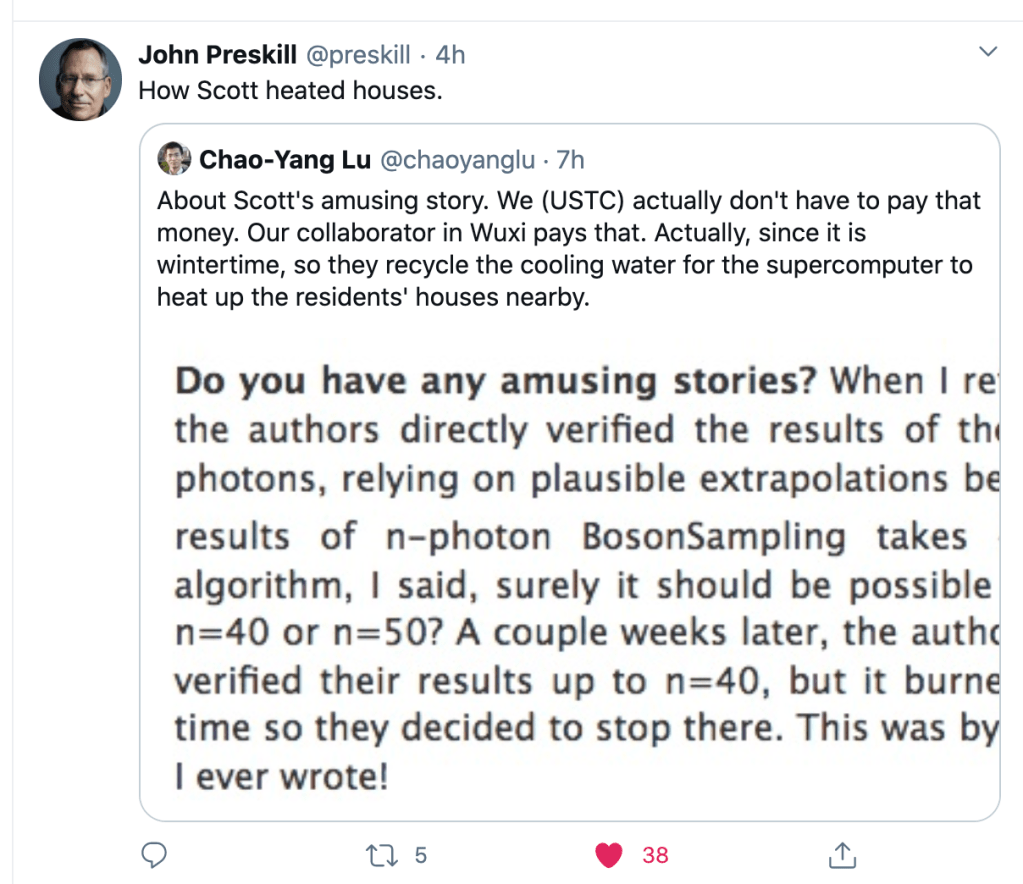
When I refereed the Science paper, I asked why the authors directly verified the results of their experiment only for up to 26-30 photons, relying on plausible extrapolations beyond that. While directly verifying the results of n-photon BosonSampling takes ~2n time for any known classical algorithm, I said, surely it should be possible with existing computers to go up to n=40 or n=50? A couple weeks later, the authors responded, saying that they’d now verified their results up to n=40, but it burned $400,000 worth of supercomputer time so they decided to stop there”

the conversation on Twitter, tha authors did not get properly billed, their sponsor footed the bill, also becasu all went into residentail heating of the nearby houses https://twitter.com/preskill/status/1334900457894891520

of Biochemistry and Geometry

some Nobel prize was awarded 50 years ago to someone who claimed a protein’s shape could be derived from the atoms building it, so it started a rece at guessing how a protein would fold, folding proteins in short. It came to artificial intelligence news this week, Alpha Fold of Deepmin won some protein-folding olympics https://www.nature.com/articles/d41586-020-03348-4

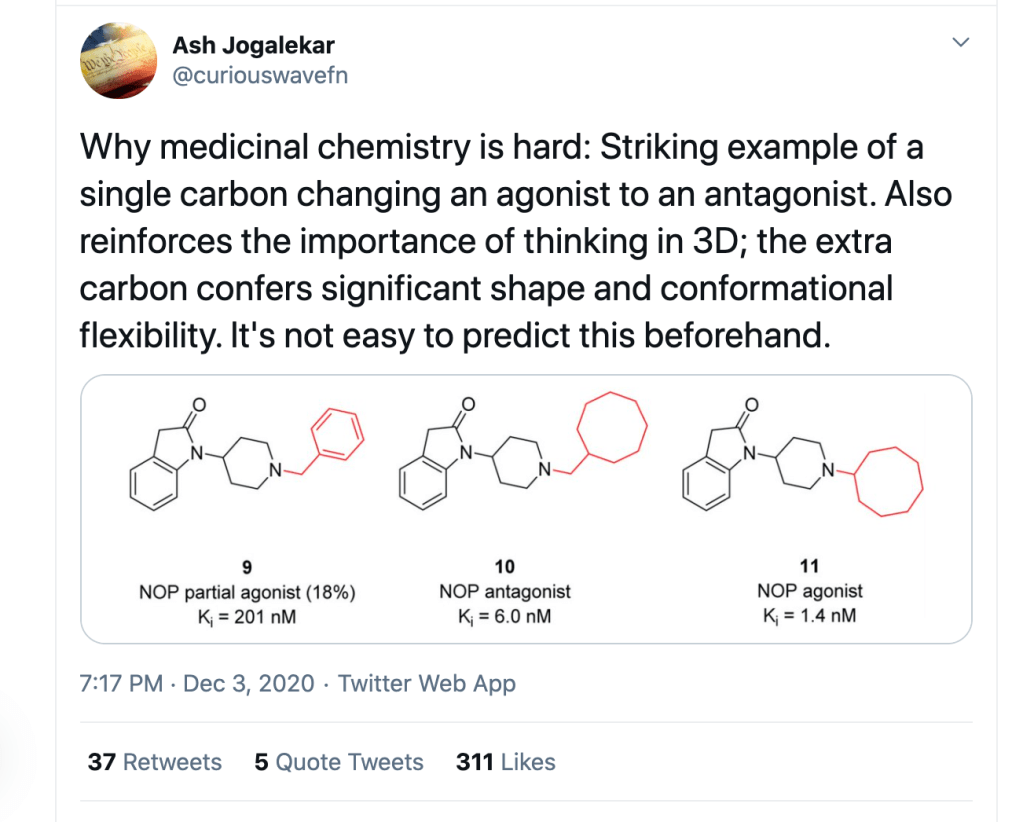
Twitter reminds me how important and difficult to deal with, is atom’s position in a molecule, detrmining properties https://twitter.com/curiouswavefn/status/1334562488495423489

while reading PIHKAL di Shulgin you can find a chapter named the 4-posiyion where it shows how halucinogenic potency derives from molecules taking the 4- position in a benzene circlae and stay there while in our body

Chips and disruption

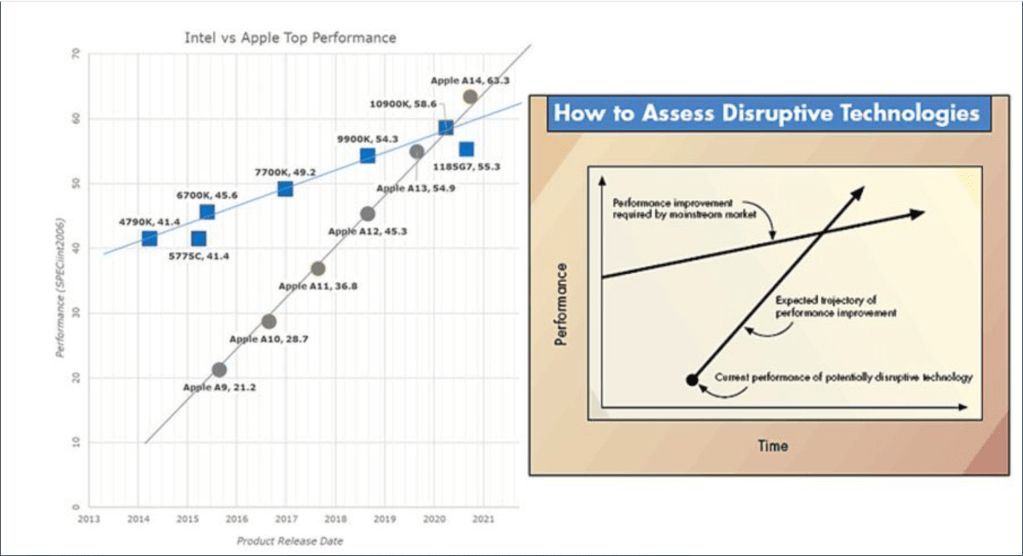
Forget those abuser startupper who banter of disruption every 3 words. We just had the most classical, Christensen-approved, disruption and involved Apple and Intel, not pizza&figs

Apple ARM chip just got more powerful than Intel’s x86 and will zoonotically colonize the Mac Power Book. Chart from this intereseting medium on Intel and disruption https://jamesallworth.medium.com/intels-disruption-is-now-complete-d4fa771f0f2c

that could be read in the tea leaves, no, in the tech trajectories already long time ago, Daring Fireball did it in 2015 https://daringfireball.net/2015/11/the_ipad_pro

Truth be told, Christensen did (not) explain that to Grove in the late 90’s and Intel could pull the Celeron out of the magic cap and so avoid disruption then, Plan Maestro had the story in 2016 https://twitter.com/PlanMaestro/status/712103828426870784

rationality and ergodicity

classical economics postulates a human being strongly rational and developed the Expected Utility Theory for decisions in regime of uncertainty.

I got out of my economics study last century with the rather strong faith conviction that the basis of rationality in economic behaviours makes impossible to justify cooperation on rational ground.

And really it was not just me, some people had to build ad hoc theories to justify cooperation in terms of social capital, while some other simply took to show how the rationality hypothesis of human behaviour is really not grounded in reality, so behavioural economics is born and “people are “dumber and nicer” and more human compared to “econs” described in graduate economics texts”

Then lately I discover something funnily named ergodicity economics, got confused and took me a while to understand that it really describes a non-ergodic economics, models where the the ergodic hypothesis which is implicitely made in the Expected Utility Theory is abandoned.

A non-ergodic model better describes the economics and financial world and such model can retaina stronger definition of individual rational and has better chances to rebuild economics than chipping it away with the nudges criticism.

Utility Theory was built in the 18th century based on this “mistake” to think probability additive, made of independent events, while in reality, wealth accumulates over time and therefore when you consider probability of betting it becomes multiplicative, you have the St.Petersburg Paradox and maybe a cascade of consequences that brigns to my “rational man cannot cooperate” belief in university carried over to last here. Then I met the Farmers Fable and I got to love ergodicity economics (which is, a new foiundation of economics on non-ergodic pillars)

UPDATE march 22, 2021. Higher up I write “I got out of my economics study last century with the rather faith conviction that the basis of rationality in economic behaviours makes imposible any cooperation” but I cannot remember precisely which part of economic theory gave me this impression. Today, searching, I got to this paper of AMartya Sen “RATIONALITY AND UNCERTAINTY” http://homepage.sns.it/hosni/lori/readings/Sen%20-%201985%20-%20Rationality%20and%20uncertainty.pdf

The self-interest approach is crucial to the derivation of certain central results in traditional and modern economic theory, e.g., the Pareto optimality of competitive equilibria. / The traditional theory of utility provides a seemingly firm basis for the rationality of pursuing one’s utility – defined either in terms of Benthamite hedonism of pleasure calculus, or in terms of various formulations of desire-fulfilment. In fact, ambiguities in the concepts of ‘utility’ and ‘preference’ have played quite a substantial part in intermediating between self-interest and choice, giving the appearance of tying rational choice firmly to the pursuit of self-interest”

and elsewhere I guess trouble got crystallised with Samuelson formalisation, Samuelson considered ergodicity essential to make economics scientific (citation neeeded)

citation found, apparently Samuelson once said that economics can’t be scientific if you drop the erogodic assumption https://rwer.wordpress.com/2013/02/12/ergodicity-the-biggest-mistake-ever-made-in-economics/

and here https://larspsyll.wordpress.com/2012/08/07/paul-samuelson-and-the-ergodic-hypothesis/
shaky foundation of economics

still on the issue of the cancelled singularity

a dinner chat between a physicist and an economist on the physical limits to infinite growth , the infinite growth postulated by economists in their models.

I got there from this tweet on ergodicity economics https://twitter.com/DrCirillo/status/1201782869712146432

and gave another read to Ole Peter’s Nature paper which sinks deeper in my reasoning on economics.

It all started because some economist on Facebook complained that some other economist had opposing views, but this is not the point, he started with an “in science, no economic theory …” science and economics so close in one sentence got me thinking about epistemics

a comprehensive article on “is economics a science?” lots of quotes so probably it isn’t you would not need so many instead

EDIT: I found today Noah Smith arguing that economic policy today seems limited to “Give poeple money” without any attempt to ground the directive in theory, unlike what happened in 2008 crisis where economists resorted to theory and in course they wrecked the economy even more. So the state of economics, macroeconomics I mean, is dismal https://noahpinion.substack.com/p/the-new-macro-give-people-money

UPDATE june2021:I had not realized that Noah Smith had a rebuttal of the physicts and economist dialogue https://noahpinion.substack.com/p/murphys-law-or-follies-of-a-finite

efficient markets, or not

on askblog I read of Fama efficient market hypothesis and monetary policy https://www.arnoldkling.com/blog/finance-theory-and-the-fed/

he says that “Actually, the central banks don’t do anything real. They are issuing one form of debt to buy another form of debt. If you are an old Modigliani–Miller person the way I am, you think that’s a neutral activity: You’re issuing short-term debt to buy long-term debt or vice-versa. That’s not something that should have any real effects

I should study the Efficient Market hing. It also prompted me to punt on reading list Mandelbrot The (Mis)Behavior of Markets https://www.goodreads.com/book/show/665134.The_Mis_Behavior_of_Markets

things to grow