Some tech are deflationary and at every bubble burst interest rates go lower
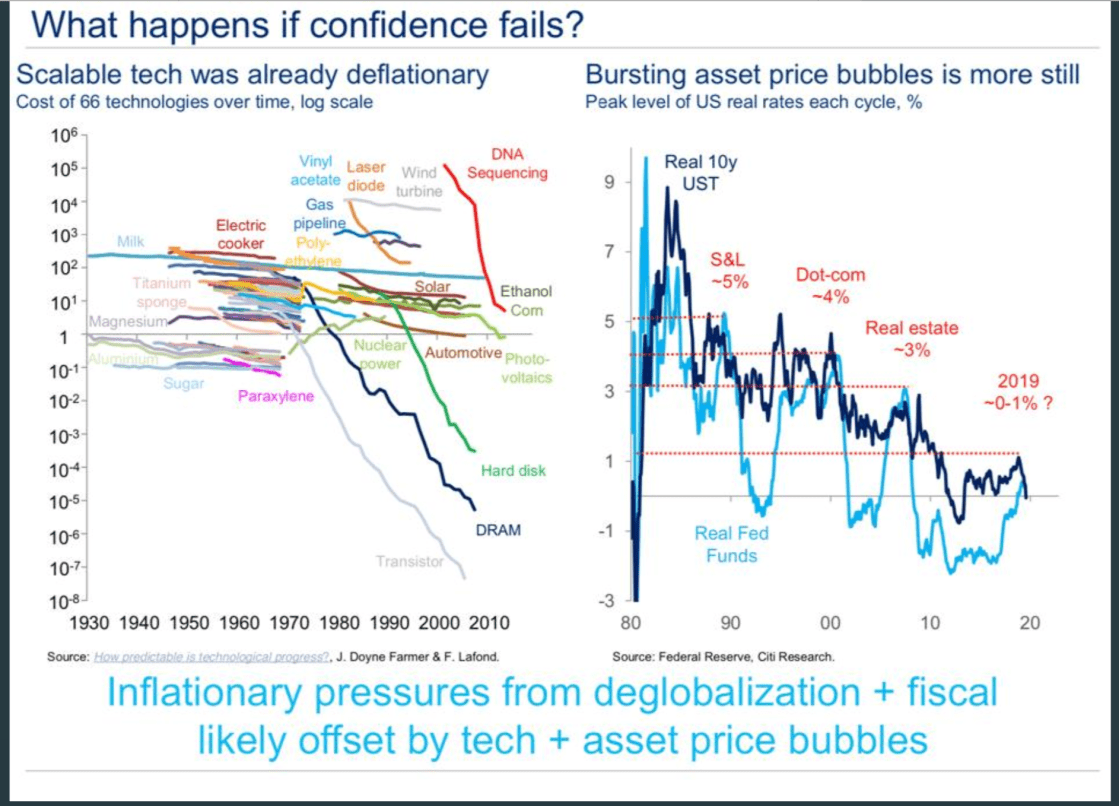
form here
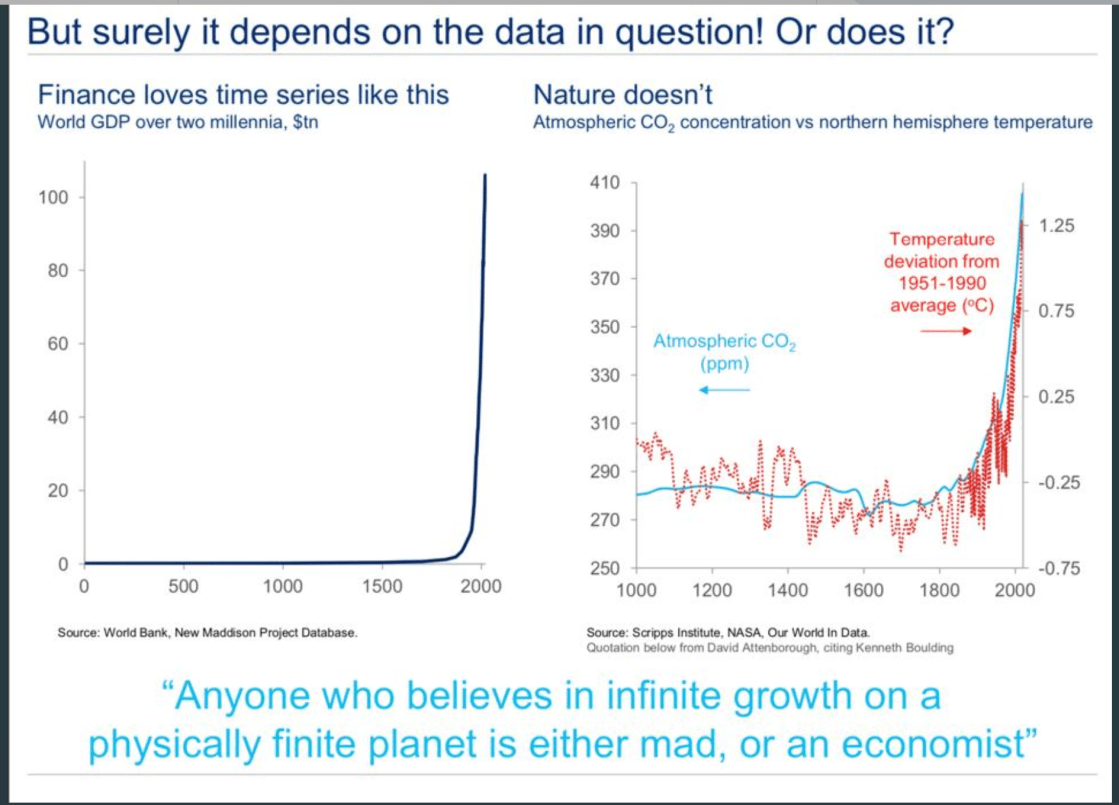
where it also shows that exponential does not goes well with natural phenomena
Some tech are deflationary and at every bubble burst interest rates go lower
form here
where it also shows that exponential does not goes well with natural phenomena
Paper: The Geography of Unconventional Innovation
Kedrosky in his newsletter: “the primary benefit of doing startups in dense cities (to a point) is that it increases the likelihood of “collisions”, of people, by chance, running into other people. That can lead to an exchange of ideas, which provokes new ways of thinking, and sometimes turns into innovations”
apparently only VC’s should never become clubby and stop colliding with people
etting Tired of Your Friends: The Dynamics of Venture Capital Relationships
“The philosopher Simone Weil (1909–1943) crisply explained why what we have come to call a “free market of ideas” must fail: facts cost labor, fictions do not. “
“We embrace the notion of a “free market of ideas” because it appeals to our egos. It bubbles to the top of the trope froth because it appeals to a human weakness: our overestimation of our expertise in areas where we lack it. For just this reason, we are vulnerable to people who tell us that we are smart enough to discern the truth from overwhelming stimuli”
Timothy Snyder on the Turing Test as a parable on the multiple dimensions of human mind showing us how how digital is threatening our future. It’s not simply a computer we mistake as human, it’s sexuality, rationality, empathy and the sheer possibility to find truth in facts in a digital world
What Turing Told Us About the Digital Threat to a Human Future
“From Milton’s Areopagitica (1644) to Twitter’s post-Trump apologia, an Anglo-Saxon tradition holds that truth emerges from unhindered exposure to whatever happens to be in the culture at a given moment. This is an error. Free speech is a necessary condition of truth, but it is not a sufficient one. The right to speak does not teach us how to speak, nor how to hear what others say. We can only gain the analytical capacity of C as a result of education, which competition itself never provides. Even if we are analytic like C, we also need A’s empathy to judge motivations and contexts. And even if we have the qualities of both C and A, we are powerless without B, the caretaker of facts. We can only reason from the facts we are given, which competition itself never generates. The philosopher Simone Weil (1909–1943) crisply explained why what we have come to call a “free market of ideas” must fail: facts cost labor, fictions do not.”
Related, Morozov on Joi Ito – MIT – Epstein
The Epstein scandal at MIT shows the moral bankruptcy of techno-elites
“For one, we are no longer in 2009: Mark Zuckerberg’s sophomoric musings on transparency or the global village impress very few.”
The Third Culture – Brockman (1991)
(forgive me starting with Simone Weil and ending with Brockman “As Brockman himself put it after one such dinner in 2004, “last year we tried ‘The Science Dinner’. Everyone yawned. So this year, it’s back to the money-sex-power thing with ‘The Billionaires’ Dinner’.”)
UPDATE 13/11/19 Stratechery on the Marketplace of Ideas re the debate on Facebook and free speech
UPDATE 01/03/20 ideas market failure leads of ideology sovereignty “If all information is seen as part of a war, out go any dreams of a global information space where ideas flow freely, bolstering deliberative democracy. Instead, the best future one can hope for is an ‘information peace’, in which each side respects the other’s ‘information sovereignty’: a favoured concept of both Beijing and Moscow, and essentially a cover for enforcing censorship.”
This is Not Propaganda –
UPDATE 19/01/21 excerpt from How Fascism Works, The Politics of Us and Them –
Whether rightly or wrongly, many associate Mill’s On Liberty with the motif of a “marketplace of ideas,” a realm that, if left to operate on its own, will drive out prejudice and falsehood and produce knowledge. But the notion of a “marketplace of ideas,” like that of a free market generally, is predicated on a utopian conception of consumers. pag.59
The argument from the “marketplace of ideas” model for free speech works only if the underlying disposition of the society is to accept the force of reason over the power of irrational resentments and prejudice. pag.60
UPDATE 15/02/21 from Soshana Zuboff on Facebook and the coup, opinion on the NYTimes https://www.nytimes.com/2021/01/29/opinion/sunday/facebook-surveillance-society-technology.html
For many who hold freedom of speech as a sacred right, Justice Oliver Wendell Holmes’s 1919 dissenting opinion in Abrams v. United States is a touchstone. “The ultimate good desired is better reached by free trade in ideas,” he wrote. “The best test of truth is the power of the thought to get itself accepted in the competition of the market.”
Tyler Cowen gets asked why he thinks important thinkes of the future will be religious ones, he gives 6 reasons why and numebr, while not worded so, it the right one: “facts cost labor, fiction do not” https://marginalrevolution.com/marginalrevolution/2021/02/why-will-the-important-thinkers-of-the-future-be-religious-ones.html
Facebook under trustbusters pressure dare not creating its own mobile payment system so creates a cryptocurrency that entrusts to an association in Geneva and than a moblie payment company it owns
Not quiet like Standard Oil trust but in way serving the sma purpose. Standard Oil dominated the oil sector in USA but it did not show up in ownership concentration: it had no share in other companies although it really owned them all: the companies were owned by respective owners who in turn particpiated in the trust that owned standard oil
“One executive from the group could explain to a committee of the New York State Legislature that relations among 90 percent or so of the refineries in the country were “pleasant” and that they just happened to work together “in harmony.” And another could assure the same committee that his own firm had no connection to Standard Oil and that his only personal relationship was as “a clamorer for dividends.” That was the real clue to the organization. It was the stockholders of Standard Oil, not Standard Oil itself, who owned shares in the other firms. At that time, corporations themselves could not own stock in other corporations. The shares were held in “trust,” not for the Standard Oil Company of Ohio, but on behalf of the stockholders of that corporation.”
Excerpt From: Yergin, Daniel. “The Prize”. Apple Books.
Relevant Market https://www.mercatus.org/bridge/commentary/facebook-and-antitrust-part-1-what-relevant-market
Consumer Harm https://www.mercatus.org/bridge/commentary/facebook-and-antitrust-part-2-where-consumer-harm
don t forget to check for part 3
Part 3: Will structural remedies solve allegd problems ? https://www.mercatus.org/bridge/commentary/facebook-and-antitrust-part-3-will-structural-remedies-solve-alleged-problems
Ben Evans says that algo is necessary, the newsfeed can’t be consumed if it’s not algorithmic,necessary evil ? Whenever I read himthe death of the newsfedeed seems his defense against thinking of any action against GAFA monopolies
https://www.ben-evans.com/benedictevans/2018/4/2/the-death-of-the-newsfeed
On the other hand I alway think I should be able to plug my algo’s and filters to my newsfeed, and Cory Doctorow nails it in his request to promote interoperability, Subject platform to rules but exempt syndication services from all. I should be able to let my 3rd-party provider of choice organize my online world, not Zuckerberg
(citations needed)
“In its first decades, the oil business provided an industrializing world with a product called by the made-up name of “kerosene” and known as the “new light,” which pushed back the night and extended the working day. At the end of the nineteenth century, John D. Rockefeller had become the richest man in the United States, mostly from the sale of kerosene. Gasoline was then only an almost useless by-product, which sometimes managed to be sold for as much as two cents a gallon, and, when it could not be sold at all, was run out into rivers at night. But just as the invention of the incandescent light bulb seemed to signal the obsolescence of the oil industry, a new era opened with the development of the internal combustion engine powered by gasoline.”
Excerpt From: Yergin, Daniel. “The Prize”. Apple Books.
From the 2008 preface. The idea that a revolution will happen only once PV energy will be priced so low that it will be sold cheap, dispersed into ground, wasted. Before new application will be found and revolutionise the world (hydrogen? what else?)
Comes to me from reading Gilder and Telecosm, this quote found on wired by googleing “waste the bandwidth” the tagline of Gilder’s book that stuck to me:
“You had to “waste” the power of the steam engine and its derivatives in order to prevail, whether in war or in peace. Over the last 30 years, we’ve seen transistors (or switching power) move from being expensive, crafted vacuum tubes to being virtually free. So today, the prime rule of thrift in business is “waste transistors.” We “waste” them to correct our spelling, to play solitaire, to do anything. As a matter of fact, you’ve got to waste transistors in order to succeed in business these days.
My thesis is that bandwidth is going to be virtually free in the next era in the same way that transistors are in this era. “
Now it’s paywall, should i link it ? Ok I ll link it https://www.wired.com/1993/04/gilder-4/
https://mcluhangalaxy.wordpress.com/2016/04/19/man-becomes-the-sex-organs-of-the-machine-world/
artists adjust faster to technology chage and become visionary and oraculars”
McLuhan prefers so a poetic tone and prose
Communication is transforative not only because it alter the physical and social boundaries of everyone’s reality, but because they change the metaphors and the perceptual tools available to interpretation
medium is the message “The boldness of his writing lay in its assertion these tools and media were not merely convenient adjuncts and servants to a lofty and autonomous human nature; rather, the tools and media themselves were an integral part of the crucible wherein that human nature and its underlying worldviews were formed”
“We shape our tools and thereafter our tools shape us” — Marshall McLuhan
Ben Evans “Hence, channeling Marshall McLuhan, new tools start out being made to fit the existing workflows, but over time the workflows change to fit the tools.”
https://www.ben-evans.com/benedictevans/2015/5/21/office-messaging-and-verbs
In a post speaking of Slack and sw envirnments for productivity
“Ironically, Lotus Notes, one of the earliest corporate messaging programs, was intended to be much more than email, calendaring and so on – there was a vision of a unified development environment, database and messaging system – ‘groupware’. It didn’t quite work out like that, and actually using Lotus Notes as I had to 15 years ago was rather like using an email client built with Microsoft Access – theoretically possible but not a very good idea. OLE in the 1990s was another concept that didn’t quite work, embedding pieces of one program’s document inside another. But today, Facebook’s platform on the desktop is pretty much Ray Ozzie’s vision built all over again but for consumers instead of enterprise and for cat pictures instead of sales forecasts – a combination of messaging with embedded applications and many different data types and views for different tasks. Hence, one could propose one future model as ‘Facebook for the enterprise’, but with the platform, not the social, being the point of the analogy.”
started from a post on Microsoft capitulation, giving up on Windows everywhere which in hindsight helped to go back on top of the tech world
https://www.ben-evans.com/benedictevans/2015/7/8/capitulation
This is turning into Ben Evans quotes “That is, Google tests new opportunities to see if they fit in the same way that a shark bites a surfer to see if they’re a seal. If not, you don’t change Google to fit the opportunity – you spit out the surfer (or what’s left of him). ”
Google as a “vast machine learning engine”
https://www.ben-evans.com/benedictevans/2015/4/14/what-does-google-need-on-mobile
 1500-Pound Goat