Robots and productivity

Krugman says not to blame robots for low wages since productivity is stagnating

Acemoglu says we should worry now since the transition to AI won’t be like the transition from agriculture to industry, productivity will increase, share of labour decrease, salries might decrease

https://www.project-syndicate.org/commentary/ai-automation-labor-productivity-by-daron-acemoglu-and-pascual-restrepo-2019-03


Acemoglu again says that taxation favours robots over workers, i.e. ccelerated depreciation of investments in machinery and software in USA put tax on robots at 5% vs tax on humans at 28% https://www.brookings.edu/bpea-articles/does-the-u-s-tax-code-favor-automation/

Screenshot 2020-09-21 at 16.07.20

migrants and their home

Syrian refugees find Turkey more welcoming than western Europe Economist in 2018

Africa’s Only Hope Is Industrialization The continent has a chance to pick up some of the manufacturing leaving higher-cost Asia. Noah Opinion reviewing The Next Factory of the World

Screenshot 2019-05-21 at 10.28.53

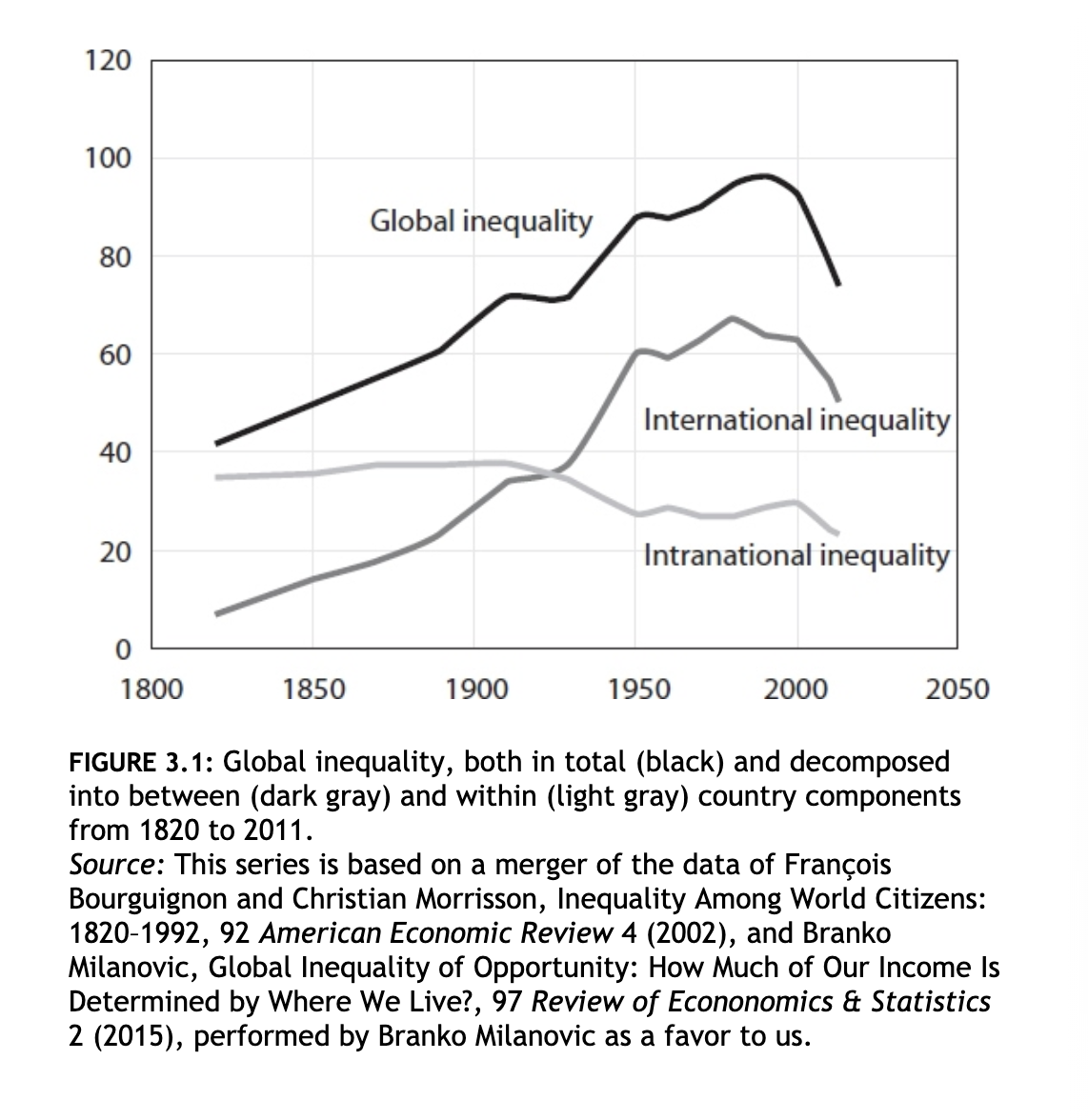
In Radical Markets by Eric Posner, the historic growth of  Global inequality versus intranational inequalityScreenshot 2019-05-21 at 10.33.50

Posner advocates generalising the sponsorship system that now is available only to companies.

Superstar firm, markups and competition

article on the Economist https://www.economist.com/finance-and-economics/2019/04/04/the-imf-adds-to-a-chorus-of-concern-about-competition about the rise of markeups, concentration of that rise on 10% of superstar firms, role of intangibles

Screenshot 2019-04-29 at 15.49.12

“Economists are sometimes accused of having “physics envy”—that is, of coveting the precision of the hard sciences. But if economics has a law worthy of the name, it is that firms prefer to merge than to compete.” unsurprisingly, top move in McKinsey book

structure and individual

from “The Next Factory of the World: How Chinese Investment Is Reshaping Africa”

Structural forces are suggestive but not decisive. Personal commitment and company-level ingenuity still count”

from the seminal paper where the rationality of the economic actor is discussed (go search for it, old paper from maybe 1965 circa, quoted by Beatrice Cherrier on twitter https://twitter.com/Undercoverhist

something related here, https://twitter.com/Undercoverhist/status/1120074472386641920)

economic actors can diverge from economic rationality, like for example disregarding maximitation and ignoring constraints, but once non-rationaly gets them in the red and broke they probably fall back into economic rationality, which as a whole still well describe the economic actor

memo: Flying Geese Theory

Causal inference, Nobel, Kruegman

screenshot in case twit goes away Screenshot 2019-03-30 at 12.30.52

Hal Varian explains causal inference in economics and marketing

Krueger study on restaurant that kickstarged causal inference and natural experiments in economics Minimum Wages and Employment: A Case Study of the Fast Food Industry in New Jersey and Pennsylvania

BTW I had to edit all the causal in the post since I had written casual, maybe denotes my idea on the issue 🙂

radical markets

chapter 1 COST common ownership self-assessed tax http://radicalmarkets.com/chapters/property-is-monopoly/

Texas shootout: https://www.mediate.com/articles/spoelstra6.cfm

Harberger taxes

https://en.wikipedia.org/wiki/Myerson%E2%80%93Satterthwaite_theorem

The Myerson–Satterthwaite theorem is among the most remarkable and universally applicable negative results in economics—a kind of negative mirror to the fundamental theorems of welfare economics. It is, however, much less famous than those results or Arrow’s earlier result on the impossibility of satisfactory electoral systems.

curio: Vitalik Buterin on radical markets https://vitalik.ca/general/2018/04/20/radical_markets.html