Robots and productivity

Krugman says not to blame robots for low wages since productivity is stagnating

Acemoglu says we should worry now since the transition to AI won’t be like the transition from agriculture to industry, productivity will increase, share of labour decrease, salries might decrease

https://www.project-syndicate.org/commentary/ai-automation-labor-productivity-by-daron-acemoglu-and-pascual-restrepo-2019-03


Acemoglu again says that taxation favours robots over workers, i.e. ccelerated depreciation of investments in machinery and software in USA put tax on robots at 5% vs tax on humans at 28% https://www.brookings.edu/bpea-articles/does-the-u-s-tax-code-favor-automation/

Screenshot 2020-09-21 at 16.07.20

migrants and their home

Syrian refugees find Turkey more welcoming than western Europe Economist in 2018

Africa’s Only Hope Is Industrialization The continent has a chance to pick up some of the manufacturing leaving higher-cost Asia. Noah Opinion reviewing The Next Factory of the World

Screenshot 2019-05-21 at 10.28.53

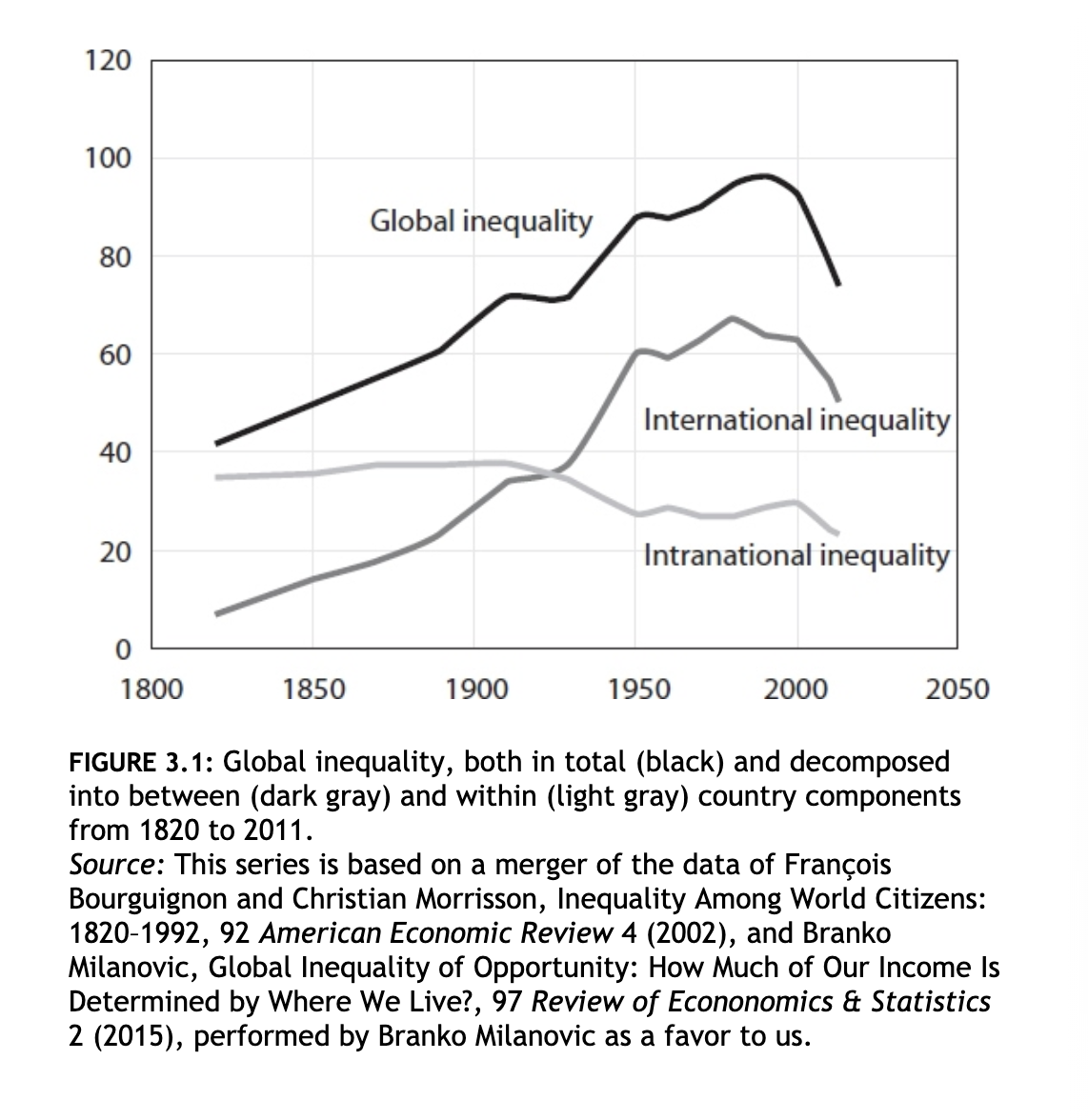
In Radical Markets by Eric Posner, the historic growth of  Global inequality versus intranational inequalityScreenshot 2019-05-21 at 10.33.50

Posner advocates generalising the sponsorship system that now is available only to companies.

monopoly? protection of locked-in customer

Why on earth the debate on Facebook has been framed as monopoly and breaking the monopoly ? The internet is infinite so there will be no monopoly.

https://marginalrevolution.com/marginalrevolution/2019/05/nick-clegg-on-breaking-up-facebook.html

Rather, social networks structurally lock in their users, let’s talk about abusing locked-in users and acting against facebook in order to protect the rights of locked-in users. In the end we should be talking of ownership od data, social graphs etc

This guy claims instead that Facebook  should be regulated as a monopsony of our attention, but in this case isn’t the monopsony a consequence of the more fundamental lock-in mechanics? He cares for the effect on media monetization though ” The problem there is that Facebook has also usurped much of those outlets’ advertising, negating the monetization potential of the very distribution they provide. (That’s largely the result of an advertising paradigm that Google created and Facebook expanded on, which flipped the power in advertising from publishers selling audiences—the readers of a publication—to advertisers targeting specific individuals based on their own data, or that of intermediaries like Facebook. The publisher went from a media price-setter to a price-taker, and prices plunged.) ”

https://www.wired.com/story/facebook-not-monopoly-but-should-broken-up/

lose lose lose (ride-hailing)

Uber loses money but gets 8 bln funding with IPO

Uber drivers complain of falling compensations

Cities complain of growing traffic, Uber competitor of public transport

still, money piles up awaiting maybe (surely) awaiting to monopolistic power (network egffects, increasing economies of scale) when either one:

screw drivers

replace them with AI

screw clients

screw the cities force them to ban private cars

never know what monopolists could do, what are the policy option now since costs are falling on various categories ?

Economist article Public Distress


a law on how computing consumes less than radio-ing

“Transmitting bits of information, even with approaches like bluetooth low energy, is in the tens to hundreds of milliwatts in the best of circumstances at comparatively short range. The efficiency of radio transmission doesn’t seem to be improving dramatically over time either, there seem to be some tough hurdles imposed by physics that make improvements hard.

On a happier note, capturing data through sensors doesn’t suffer from the same problem. There are microphones, accelerometers, and even image sensors that operate well below a milliwatt, even down to tens of microwatts. The same is true for arithmetic. Microprocessors and DSPs are able to process tens or hundreds of millions of calculations for under a milliwatt, even with existing technologies, and much more efficient low-energy accelerators are on the horizon.”

What this means is that most data that’s being captured by sensors in the embedded world is just being discarded, without being analyzed at all.

Scaling machine learning models to embedded devices

UPDATE an example of things moving in that space, startup with chip to move AI to the “edge” https://techcrunch.com/2019/05/20/quadric-io-raises-15m-to-build-a-plug-and-play-supercomputer-for-autonomous-systems/


the funny thing between ridesharing and autonomous driving

Waymo robotaxis for hire in Phoenix via Lyft

Google has invested in Lyft, Lyft is tanking on the stock market. Uber is listing soon, Google is invested there too, 4 bln among the 2 companies. Tesla is uberizing

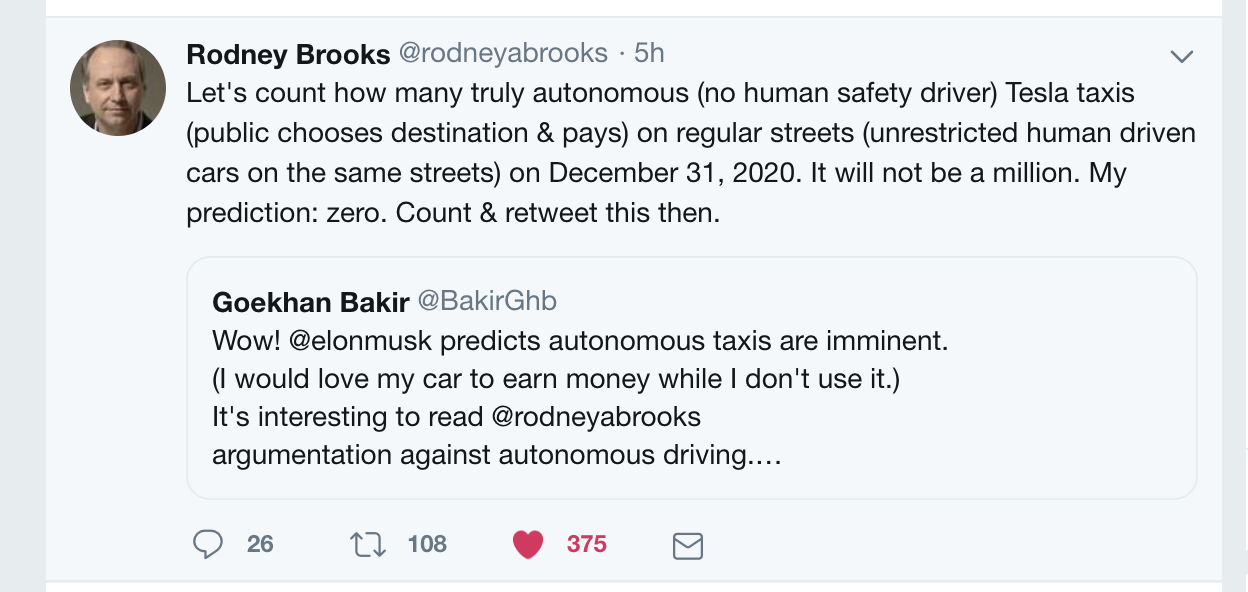
Rodney Brooks says no way 1 million level5 roboTesla on the road in 2020, he says we’ll see none

Screenshot 2019-05-08 at 10.52.12

it is funny how ride hailing and autonomous driving are entangled in a whirlwind of smart technology and smart money, looks like the place where everyone exponential and blitzscaling should be right now. Looks risky, too