“What if we put food autonomy at the centre of urban design? In fact, what if we learned to see cities as vegetative surfaces with hyphae of structure embedded in them, rather than the reverse?
These vegetative surfaces could not be gardens or farms, nor could they be like greenhouses or precision vertical farms. The strategy underlying all of these is one of simplification in the service of scale: you select the things you want to grow, then you create a biome consisting of just those things. But recent events suggest we have exceeded the limits of marginal return to scale. (..)
The work of fashioning such a biome would bear comparison to that undertaken by the first human colonists of Australia, who used fire to create a landscape conducive to foraging – more nudging than cultivating. But it would have a vertical element. Tending these – what to call them? hanging forests? – would be a basic feature of urban life and not the remit of invisible low-wage specialists. A society where everyone was obliged to keep a hand in the basic work of getting a living from the Sun would be more resilient (..)”
Antropology, Anarchism by Graeber, mailing list on the Dawn of Everything, and I am on “beyond the Monastic Self” where Graeber talks about the 7-second conscience span and send the reader to Maurice Bloch for more neurological basis to this. SO it’s the paragrpah “A theory of Mind” on chapter 7 of Bloch’s book “In and Out of Each Other’s Bodies: Theory of Mind, Evolution, Truth, and the Nature of the Social” – Fake belef task experiment
7 seconds consciousness, Graeber quotes geographer Nigel Thrift, who quotes philosopher Mervin Donald
Looking for sources in Google I found this https://academic.oup.com/nc/article/2021/2/niab011/6224347 “Decades of timing research supports a “minimally sufficient” duration for time consciousness somewhere in the seconds’ range (Fraisse 1984; Pöppel 1989, 1997; Varela 1999; Wittmann 2011; Kent 2019), but most theories and methodologies in consciousness science only focus on the hundreds-of-milliseconds’ range (Northoff and Lamme 2020)” but I do not know this is the same thing Graebr mentions
UPDATE June 2022: reading one book review on Astral Codex Ten, precisely a book on consciousness, there is something at the end of the review which points to something similiar to Graeber’s 7 seconds of consciousness
“I think this is precisely where our concept of “my mind” comes from. Remember that our episodic memory might be exclusively formed from conscious moments, and also implicit learning gets a strong boost from consciousness. So when “we” (our brain, or the actors in the Cartesian theater) learn a “mind schema”, then this is based on the conscious moments, not on the activities in between. On this basis, it makes sense to merge all our neural activity into a single unit, which we call “I” or “my mind”. Just as we form the concept of “my body”, but even stronger, since we never “observe” different parts of our mind to be incoherent or even independent.”
GFANZ: “The Glasgow Finance Alliance for Net Zero (GFANZ) was launched in April and chaired by the UN Special Envoy on Climate Action and Finance, Mark Carney, a former governor of the Bank of England and the Finance Adviser of the United Kingdom Prime Minister for COP26. Now consisting of more than 450 banks, insurers and investment managers from 45 countries (..) “It includes such familiar names as BlackRock, Vanguard, State Street, Bank of America, HSBC, Goldman Sachs, and the like. The total assets of the GFANG members is about $130 trillion, with $63 trillion coming from banks, $57 trillion from investment managers and $10 trillion from asset owners such as pension funds “
clarification “the Lex team of the Financial Times intervened and clarified that $130 trillion is not ready funds but the total assets managed by member financial institutions of the GFANZ”
so much boasting, little less substantial committments, it is clearly a bait for governments who do not want to pay the polical costs of decarbonization at home, so would accept a “helping hand” from investors. Quotes from this great article Climate crisis, global debt, and the Fermi paradox – a proposal to the IMF
So, where is the catch ? Private investors in GFANZ want to get government guarantees in order to “derisk” their own investments, so social risk and private gain, something we have already heard of, think global crisis in 2008. Derisking is punt under the spotlight by economist Daniela Gabor as the new Washingotn Consensus, the guiding idea on internation monetary institutions in tackling the climate emergency, without tackling the inequality behind it. Here on the Guardian: Private finance won’t decarbonise our economies – but the ‘big green state’ can
Post scriptum: I think it is relevant to add here Policy Tensor’s post on funding the transition with public money, it has a lot of data on the cost of risky green projects in less developed countries, rightly say that we are back to the development themes of the 60’s of the 20th century, he offers a stark analysis of the geopolitical situations and calls for US to “securitize” the transition issue, which isn’t per se a good thing, sorta calling for a war posture.
BTW he sort of dissent with Gabor, derisking might be needed but the process should not be left in the hands of the blackrocks
generally the answer seems no, in 2100 sea level will rise and the mose dam won’t save Venice
“The imminent death of Venice due to sea-level rise is barely mentioned in Italy, and yet as long ago as 2010, its most respected marine scientists (ISMAR-CNR) spelled it out: the mobile barriers between the Adriatic and the lagoon known as Mose will be able to stop the flooding for a few decades, but “the sea will eventually rise to a level where even continuous closures will not be able to protect the city from flooding. The question is not if this will happen, only when it will happen”. https://www.theartnewspaper.com/2021/07/21/the-ipccs-predictions-of-sea-level-rise-are-why-italy-should-beg-unesco-to-put-venice-on-its-at-risk-list
“its homes aren’t hooked up toa modern sewage system, for instance. Whatever comes out goes into the canals, untreated, and festers in the lagoon’s shallows until the tides wash it away into the Adriatic, twice a day. Activating MOSE blocks that flushing action. In effect, it’s the regional-scale equivalent of a backed-up toilet. The result is tolerable if it gets pressed into service now and then, less so if the gates to the lagoon are shut on a regular basis.”
Johan presents 10 takeouts from the IPCC report which negotiators should keep in mind in Glasgow
Linear cuts of 2 billion Gton a year to have some chance to meet the 1.5 degrees target, 4 billions Gton a year to be fairly sure to meet it
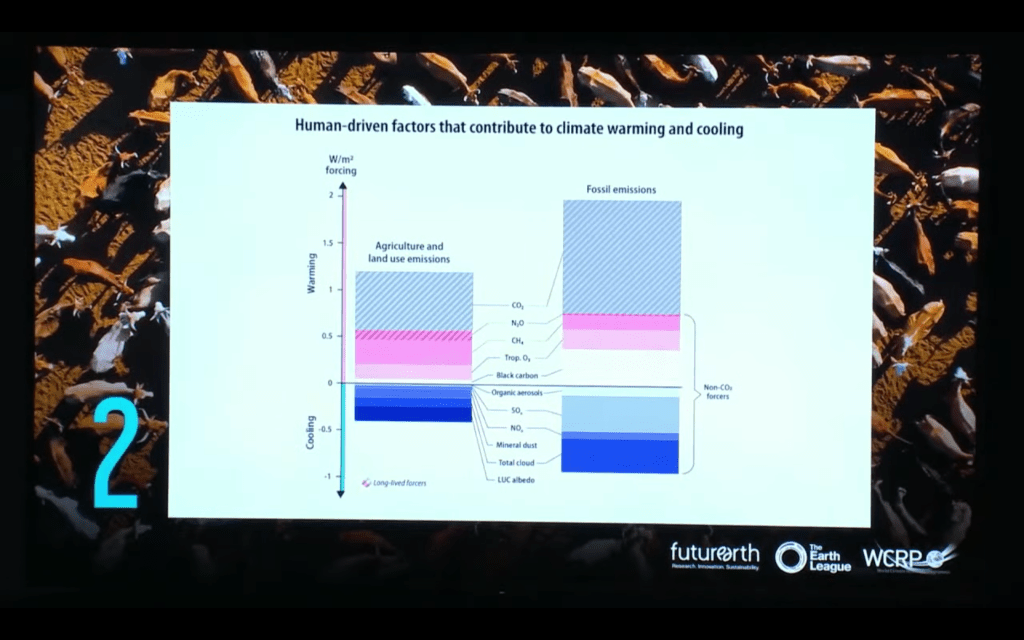
Global warming is human-made, some global warming gases are camuoflaging as beneficial aerosol but in the end are contributing to the co2 balance, this is a critical situation.
Megafires will be the new normal, and so marine life and habitat destruction
Risk of tipping points decrease at 1.5 degrees, increases at higher temps, beware of possible cascading of tipping points: cold water from the arctic into the atlantic, the amazon burns due to failing monsoons, warmer seas disintegrate the antartica shel, sea level rise. This is just one of many.
Btw, carbon markets now cover 20% of emissions but prices are high enough only in Europe
expanding on the concept of climate justice, there is a great substack by adam tooze which delves into the theme of inequality, there s great inequality between countries in emissions, but there is a bigger emissions inequality within countries, so tackling climate change requires also tackling income and wealth inequality. Case in point, emission growth in Far East is led by China, and China has higher Gini than the US; funny enough for a “communist” country https://adamtooze.substack.com/p/chartbook-newsletter-24
So, the problem is the top 10% who commands half of the world income and prodice half of the world emissions, a curve showing this dubbed the Dinosaur curve
Branko Milanovic, who is a scholar in economic inequality, focus on the 10% habit of flying arond the world and does a thought experiment: in 2020, due to coronavirus, flights were only 60% of 2019, so there is a way to keep people from flying, taxes, permits, whatever is doable. Unemployemnt in the industry, slump in tourism revenues worldwide, holidays flow will rearrange and with some govermnet money, things can smoothly become more green. Decarbonizing and averting the worst of global warming requires bold step, limiting air travel should be tried. Read here https://branko2f7.substack.com/p/climate-change-covid-and-global-inequality
invece del #clima faccio un post di pubblica utilità sul #climaPolitico, segnatevi queste cose, la politica dell’emergenza climatica si giocherà tra Fascisti Fossili, Leninisti Ecologici e Prezzatori di Carbonio
Fascismo fossile? ce n’è ancora poco ma crescerà, non vi dico dove travarlo, lui troverà voi
Al centro chi crede nel libero mercato vuole il carbon pricing, i marketplace per il permessi di emettere, perchè il price signal porterà l’equilibrio. IMF e consenso di Washington
dall’altra parte invece si pensa ci sia bisogno di politiche industriali, quelli del GREEN New DEal vogliono rifare la mobilitazione della second guerra mondiale, invece i il Green Leninism preferisce guardare al Lenin nel 1919.-21, quello di potere dei soviet e elettrificazione
Però si può anche parlare di Carbofascismo e pensare che la soluzione sia una Armata Verde a-la-Troztky come dice Mark Alizart
insomma, c’è da risolvere il clima, ma il clima politico è tutto un throwback al secolo scorso
150 trillion public/private committment to climate crisis, while the paltry 100 billion promised to less developed countries hasn’t been paid out yet. Promesse da marinaio
Daniela Gabor notes that IMF paper on climate crisis quotes 23 time “carbon pricing” and only once “industrial policy”. So imagine IMF finance conditional to setting a price on carbon, imposed on poor countries, reminiscent of stabilization policies in the 80s. Will it work ? Gabor and PolicyTensor doubt it
LRB has a second review of Malm’s book, this one is less theoretical and more historical and facts “Malm and the Zetkin Collective’s claim is not that far-right parties happen to exploit voter prejudice against both migration and climate mitigation, but that these two things are necessarily linked. They see ‘fossil fascism’ as an emergent political formation, linking ‘primitive’ fossil capital – direct extractors, which can’t survive divestment – with racist politics.” https://www.lrb.co.uk/the-paper/v43/n22/james-butler/a-coal-mine-for-every-wildfire
“Nature isn’t classical, dammit, and if you want to make a simulation of nature, you’d better make it quantum mechanical, and by golly it’s a wonderful problem, because it doesn’t look so easy.” Feynman, 1981
Chemistry is quantum computing’s killer app “quantum computers could aid development of catalysts for clean energy and renewable chemical manufacturing, enable deeper understanding of the enzymes that underlie photosynthesis and the nitrogen cycle, power the discovery of high-temperature superconductors and new materials for solar cells, and much more.”
Suddenly Sabine, who goes on saying “qubits are cheap. it’s not the number of qubits per se that’s the problem. the problem is getting out anything that isn’t just noise” https://twitter.com/skdh/status/1456293385229189122
This is a sponsored article by a UK agency which will help companies to develop applications of quantum computing, but really quantum simulation “One of those near-term applications will be to simulate the behaviour of a simple quantum system, such as a small molecule or the interactions between molecules – which some researchers think could be achieved with around 1000 qubits”



 1500-Pound Goat